
Navigating the 2G GSM Sunset for M2M Industry
2G GSM and its data-optimized extension, GPRS (2.5G), have been foundational technologies for Machine-to-Machine (M2M) communications and telemetry. By offering an “always-on,” packet-switched network architecture, GPRS dramatically lowered the costs of remote monitoring compared to traditional GSM or PSTN networks. However, facing explosive global mobile data growth and critical spectrum inefficiencies, major carriers like AT&T are sunsetting their 2G GSM networks. This whitepaper explores the technological fundamentals of 2G GSM/GPRS, its operational economics, and the required migration paths the industry must take as this legacy infrastructure is phased out.
1. The Foundations of 2G GSM and GPRS
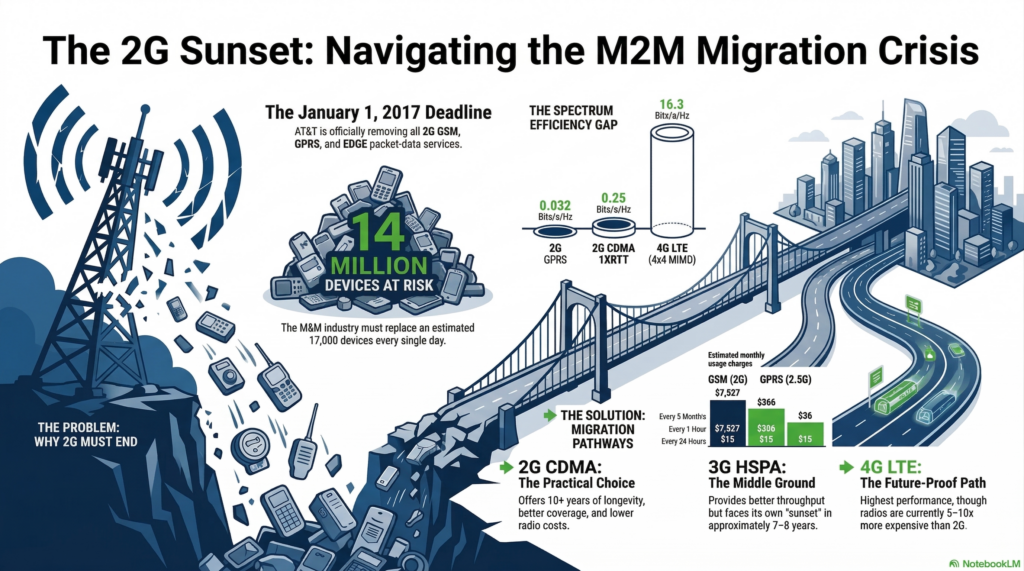
GSM (Global System for Mobile Communications) is a second-generation (2G) cellular technology that was fundamentally designed for carrying voice calls and short text messages (SMS). It operates on a circuit-switched basis, meaning that sending data requires dialing a modem through the phone system, yielding a highly constrained bandwidth of just 9,600 bits/second.
To address the growing need for data transport, Generalized Packet Radio Service (GPRS) was introduced as a 2.5G technology, serving as the next evolutionary stage for GSM networks. Unlike GSM, GPRS is packet-switched and optimized specifically for moving data natively using the Internet Protocol (IP). This IP-based architecture eliminates the need for a traditional dial-up modem at the head office, allowing field software to interface directly over the internet with corporate servers. GPRS increased bandwidth capabilities up to 38,400 bits/second, making it highly preferred for telemetry applications that need to move modest amounts of data frequently. Cost-conscious industries initially flocked to 2G GSM/GPRS because the massive global scale of GSM device sales rapidly drove down the cost of radios.
2. Economics and Spectrum Efficiency
The shift from standard GSM to GPRS fundamentally changed mobile data pricing and operational viability for automated systems. GSM usage is charged based on a flag fall and call duration, making regular data transmission prohibitively expensive. In contrast, GPRS is charged based on the volume of data transferred per session, not how often the connection is made. Furthermore, a GPRS session can remain active for up to 24 hours at no additional cost, allowing M2M devices to remain “always on” and instantly available. This pricing model made GPRS highly cost-effective for telemetry when compared to traditional GSM, SMS, or private radio networks.
Despite its operational advantages for end-users, 2G GSM/GPRS suffers from severe spectrum inefficiency for network operators. Spectrum efficiency measures the data throughput (bits/second) achieved per unit of wireless spectrum (Hertz). The theoretical maximum spectrum efficiency of 2G GSM/GPRS is substantially lower than alternative technologies; for instance, 2G CDMA 1xRTT is 3.6 times more efficient, and newer 4G LTE technologies are 120 to 230 times more efficient than GPRS. Driven by an exponential, 66% compounded annual growth rate in mobile data traffic from smartphones and tablets, carriers are under intense pressure to utilize their spectrum as efficiently as possible.
3. The 2G GSM Sunset and the Path Forward
Because of this spectrum inefficiency and the pressing need to re-use the 850MHz and 1900MHz bands for 3G and 4G network deployments, AT&T announced the complete shutdown of its 2G GSM services (including GPRS and EDGE) by January 1, 2017. In preparation for this sunset, AT&T stopped certifying new 2G GSM applications and halted the provisioning of new SIM cards for existing 2G devices.
This sunset forces the M2M industry to replace an estimated 10 to 14 million devices, a massive logistical and financial challenge that requires replacing an average of over 17,000 devices per working day. Organizations currently using 2G GSM must rapidly execute comprehensive replacement plans. Viable transition pathways include:
Transitioning to 2G CDMA: This is often the best immediate option for many M2M applications. CDMA carriers committed to long-term service longevity, the radios are relatively low cost, and the 1xRTT coverage footprint is superior to GSM/GPRS in the US.
Upgrading to 3G HSPA or 4G LTE: While 4G LTE presents a long-term solution, early LTE radio costs were 5 to 10 times more expensive than 2G GSM/CDMA radios, making them difficult to justify for low-bandwidth applications. Additionally, early LTE radios were single-band and restricted to specific carriers.
Summary
Ultimately, the obsolescence of 2G GSM signals a broader shift. M2M application providers must anticipate faster cellular technology changes in the future and design their hardware—such as using plug-in adapters or sleds for radios—to accommodate shorter product lifecycles and avoid expensive, full-system replacement costs down the line.