TETRA Rail
The Secure Backbone of Modern Railway Communication
Terrestrial Trunked Radio (TETRA) is an advanced digital standard developed by ETSI, which has become the global gold standard for mission-critical communication within the transport sector, including railways and metro systems. This white paper explores TETRA’s indispensable role in railway operations, its technical advantages, and its future integration into smart railway systems.
1
Core Operational Requirements in the Railway Sector
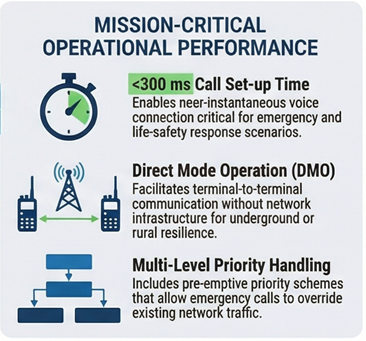
Railway operations demand extreme reliability and immediate response times. TETRA addresses these needs through unique capabilities:
- Fast call setup: With call setup times below 300 ms, critical communication between drivers and control centers is never delayed.
- Direct Mode Operation (DMO): Enables terminals to communicate directly without network infrastructure—essential for safety in tunnels or remote areas without coverage.
- Group communication: Supports one-to-many calls with unlimited group size, enabling efficient coordination of shunting, maintenance, and emergency response.
2
Integration in the “Smart Railway” Ecosystem
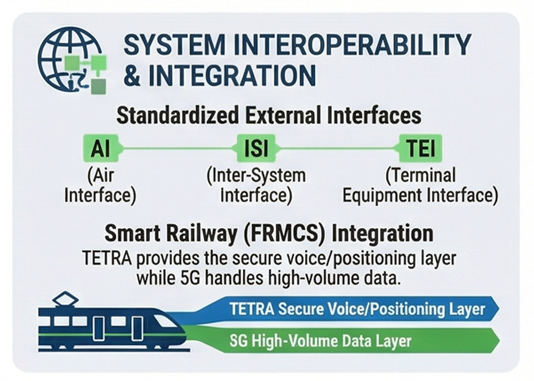
Modern railways are transitioning toward the European Future Railway Mobile Communication System (FRMCS). In this context, TETRA plays a strategic role within a hybrid environment:
- Functional split: In smart systems, 5G is used for data-intensive tasks such as AI image recognition and video streaming, while TETRA provides the secure layer for voice communication and precise positioning.
- Cost efficiency: TETRA operates in lower frequency bands, delivering longer range per base station compared to 5G. This significantly reduces the need for dense infrastructure along railway networks.
3
Advanced Railway Functions
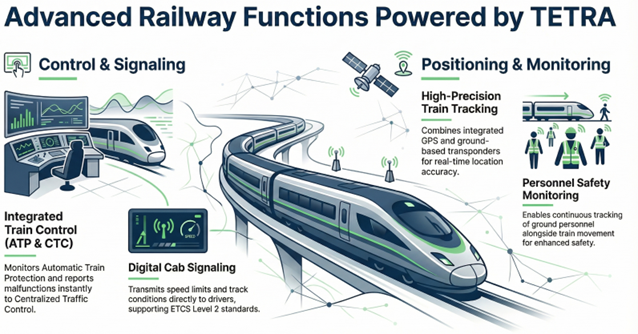
TETRA is deeply integrated into railway control systems:
- Train control (ATP & CTC): For example, Taiwan Railways (TRA) uses TETRA-based radio systems (TDRS) connected to Centralized Traffic Control (CTC) to monitor Automatic Train Protection (ATP). Any ATP malfunction is reported instantly via the TETRA network.
- Cab signaling: TETRA supports transmission of critical data such as speed limits, track conditions, and temporary instructions directly to the driver’s cab, as required for ETCS Level 2.
- Positioning and monitoring: Through integrated GPS and ground-based transponders, TETRA enables real-time tracking of trains and personnel.
4
Security and Future-Proofing
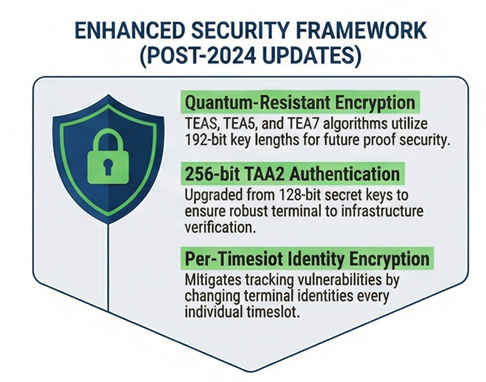
In an era of increasing cyber threats, TETRA’s security framework has been significantly enhanced:
- Encryption and authentication: Supports both Air Interface Encryption (AIE) and end-to-end encryption to prevent interception.
- Quantum-resistant algorithms: ETSI has introduced new algorithms (TEA5, TEA6, TEA7) with 192-bit key lengths to withstand future quantum computing threats.
- Vision 2040: The industry expects TETRA to remain the foundation of railway communication through 2040, as broadband alternatives (LTE/5G) have yet to match TETRA’s maturity and reliability in group voice communication.
5
Global Deployments
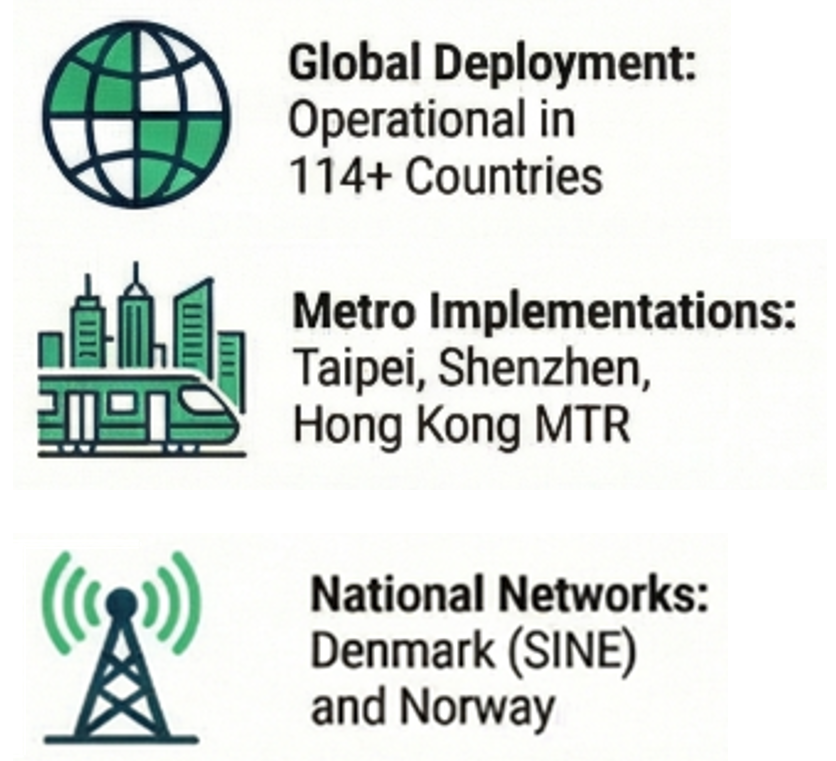
TETRA is deployed in more than 114 countries, with strong adoption in the transport sector:
- Metro systems: Implemented in Taipei Metro, Shenzhen Metro, and Hong Kong MTR for ground control and emergency management.
- National coverage: In Denmark (SINE) and Norway, TETRA ensures coordinated communication across transport and public safety sectors.
Summary
For railway operators, TETRA represents a mature, secure, and cost-efficient technology. By combining TETRA’s robust voice capabilities with broadband data services, a future-proof communication platform is created—ensuring operational efficiency and passenger safety for decades to come.