
TETRA
The Global Benchmark for Mission-Critical Communications
Terrestrial Trunked Radio (TETRA) is a highly advanced digital standard for professional mobile radio (PMR) systems developed by the European Telecommunications Standards Institute (ETSI). Designed to meet the evolving needs of government agencies, emergency services, and the military, TETRA has established itself as the global gold standard for reliable, secure, and high-performance communication.
1
Technical Architecture and Efficiency
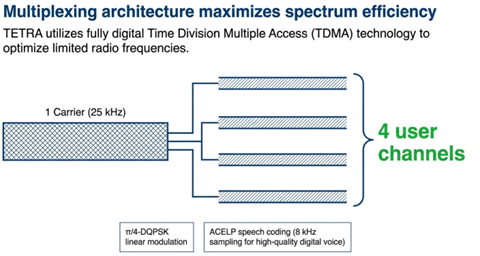
TETRA is a fully digital system utilizing Time Division Multiple Access (TDMA) technology.
- Spectrum Efficiency: The system multiplexes four user channels into a single 25 kHz radio carrier, offering excellent frequency spectrum efficiency.
- Modulation and Voice Coding: It employs -QDPSK linear modulation and ACELP (Algebraic Code-Excited Linear Prediction) speech coding, which samples audio at 8 kHz to ensure high-quality digital voice.
- Connectivity: TETRA is designed for extensive interoperability, supporting connections to public/private telephone networks (PSTN/PABX), data networks, and large command and control systems.
2
Core Mission-Critical Capabilities
The standard offers several unique features that distinguish it from public cellular technologies:
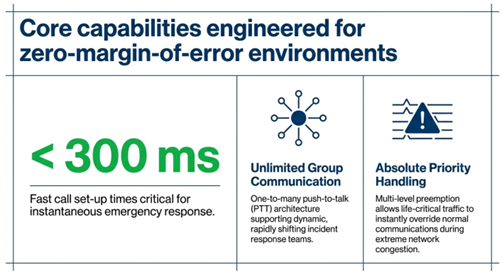
- Fast Call Set-up: Provides call establishment times of less than 300 ms, which is critical for emergency response.
- Direct Mode Operation (DMO): Allows terminals to communicate directly with one another without network infrastructure, ensuring communication continuity in areas with no coverage, such as underground or in rural settings.
- Group Communication: Supports “one-to-many” group calls with unlimited group sizes, managed via a simple push-to-talk (PTT) interface.
- Emergency & Priority Handling: Includes dedicated emergency buttons and multi-level priority schemes that allow life-critical calls to override normal traffic during network congestion.
3
Modern Security Evolution
TETRA was designed from its inception to be secure, but the framework has recently undergone significant updates to meet modern threats:
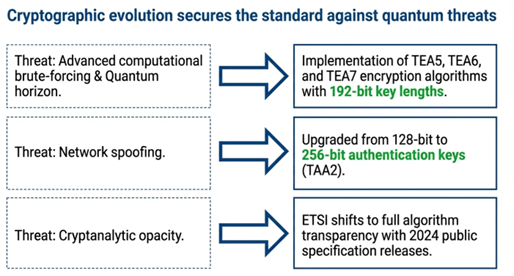
- Updated Algorithms: To counter the threat of increased computing power and the horizon of quantum computing, ETSI introduced additional encryption algorithms (TEA5, TEA6, and TEA7) with 192-bit key lengths.
- Enhanced Authentication: Original 128-bit authentication secret keys have been upgraded to 256-bit keys (TAA2 set).
- Addressing Vulnerabilities: Revised standards (2022–2024) introduced mitigations for the “TETRA:BURST” disclosures, including a new identity encryption system that changes the terminal’s identity every timeslot to prevent tracking.
- Public Disclosure: In a shift toward transparency and widespread cryptanalysis, ETSI released the algorithm specifications in 2024
4
Strategic Industry Applications
TETRA’s reliability makes it the preferred choice for several vital sectors:
- Public Safety: National networks like SINE in Denmark and PIT in Italy provide cross-agency communication for police, fire, and ambulance services.
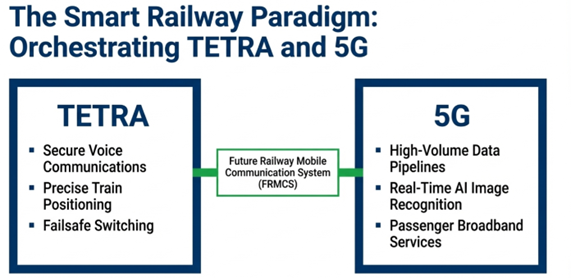
- Smart Railways: Integrated into the Future Railway Mobile Communication System (FRMCS), TETRA provides the secure voice and positioning layer, while 5G handles high-volume data such as AI image recognition.
- Transportation & Logistics: Used extensively in major airports (e.g., Narita and Barcelona) and metro systems (e.g., Taipei and Shenzhen) for ground control and emergency management.
5
Vision 2040: The Hybrid Era
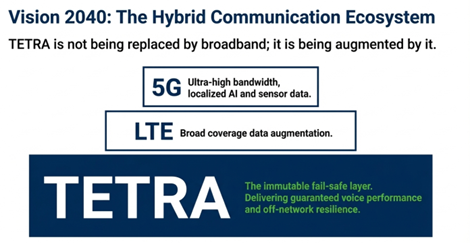
While broadband technologies like LTE and 5G offer data-rich capabilities, TETRA remains essential for its mature voice performance and off-network resilience
- Coexistence: The industry is moving toward hybrid ecosystems where TETRA serves as the dependable voice layer and broadband technology augments data services.
- Migration Decade: National migration programs are expected to continue through 2035–2040, as organizations require an extended period of dual operation to validate the reliability of mission-critical broadband..
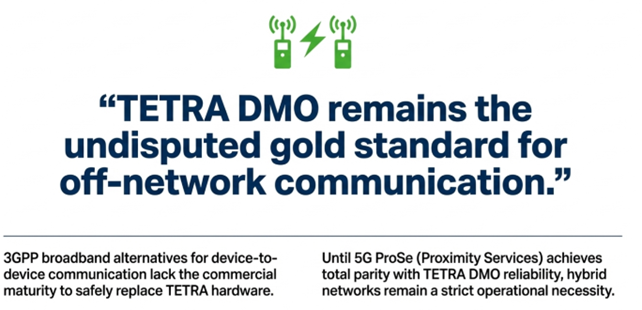
TETRA DMO remains the gold standard for device-to-device communication, as 3GPP broadband alternatives are not yet commercially mature enough to fully replace it.
Summary
TETRA is a mature, robust technology that continues to evolve. With an installed base of over 5 million terminals, ongoing investments in quantum-safe security, and its integral role in hybrid communication models, TETRA is projected to remain the foundation for mission-critical services well into the 2040s.