4G/LTE – The Unified Global LTE Standard
The transition to 4G LTE represents a paradigm shift in wireless telecommunications, moving from legacy 2G and 3G networks to a highly efficient, all-IP broadband architecture. This migration is driven by the pursuit of three fundamental benefits: unsurpassed data speed, lower total cost of ownership through increased spectral efficiency, and long-term network longevity. As operators decommission older networks, 4G LTE has emerged as the strategic platform for the next decade, capable of supporting both bandwidth-intensive consumer applications and long-term machine-to-machine (M2M) deployments. This whitepaper provides a comprehensive overview of 4G LTE, covering the migration drivers, the Evolved Packet Core (EPC) architecture, physical network considerations, the unified global standardization of FDD and TDD modes, and deployment flexibility across various frequency bands.
1. The Evolution and Migration to 4G LTE
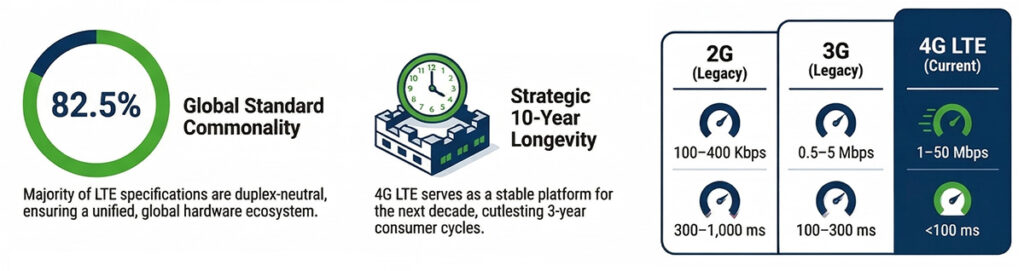
The adoption of 4G LTE is rapidly accelerating across North America, Europe, and Asia. For network professionals and corporate operators, this migration requires long-term planning, as many major carriers are shutting down older architectures; for instance, AT&T decommissioned its 2G network in 2017, and Verizon planned to terminate 2G and 3G by 2021.
Companies are pursuing 4G LTE to achieve three key benefits:
- Speed and Latency: 4G LTE offers theoretical download/upload speeds of up to 300 Mbps and significantly reduced latency (less than 100 ms), making it ideal for bandwidth-intensive applications like IP cameras, digital signage, and SCADA polling applications.
- Total Cost of Ownership: Increased spectral efficiency allows network operators to support more customers and devices with fewer towers, making LTE highly cost-effective.
- Longevity: M2M network professionals typically require a 5 to 10-year horizon, making 4G LTE the ideal strategic platform for the next decade.
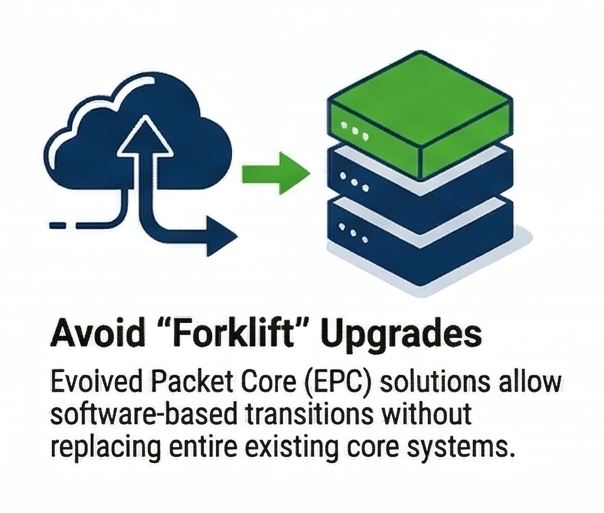
Crucially, the transition to 4G does not require a costly “forklift” upgrade; operators can leverage innovative solutions that support 2G/3G functionality now and evolve to 4G via software upgrades on a single common core platform.
2. The Evolved Packet Core (EPC) Architecture
A central component of the 4G LTE standard is the System Architecture Evolution (SAE), which calls for a transition to a simplified, flat, all-IP core network known as the Evolved Packet Core (EPC). The EPC supports higher throughput, lower latency, and seamless mobility between 3GPP (GSM, UMTS, LTE) and non-3GPP radio access technologies (like WiMAX, WiFi, and CDMA).
The EPC flattens the network topology by reducing the number of nodes involved in data processing, integrating the following key network functions:
- Mobility Management Entity (MME): Residing in the control plane, the MME manages states, authentication, paging, and roaming.
- Serving Gateway (SGW): Sitting in the user plane, the SGW forwards and routes packets to and from the eNodeB and serves as the local mobility anchor.
- Packet Data Network Gateway (PGW): The PGW interfaces between the LTE network and external Packet Data Networks (PDNs) like the Internet. It handles IP address allocation, deep packet inspection, and policy enforcement.
- Evolved Packet Data Gateway (ePDG): This element manages interworking between the EPC and untrusted non-3GPP networks, handling Quality of Service (QoS) and flow-based charging.
To ease migration, these functions can logically be integrated into a single carrier-class node, reducing signaling overhead and leveraging existing 3G deployed bases.
3. Physical Implementation Considerations
Migrating to 4G LTE requires network administrators to adapt to new hardware and physical layer complexities. The EPC flattens the network topology by reducing the number of nodes involved in data processing, integrating the following key network functions:
- SIM Cards and APNs: Unlike older CDMA networks, LTE universally uses SIM cards to authenticate devices and identify data services. It also utilizes Access Point Names (APNs) to determine IP addressing and establish secure private network routing.
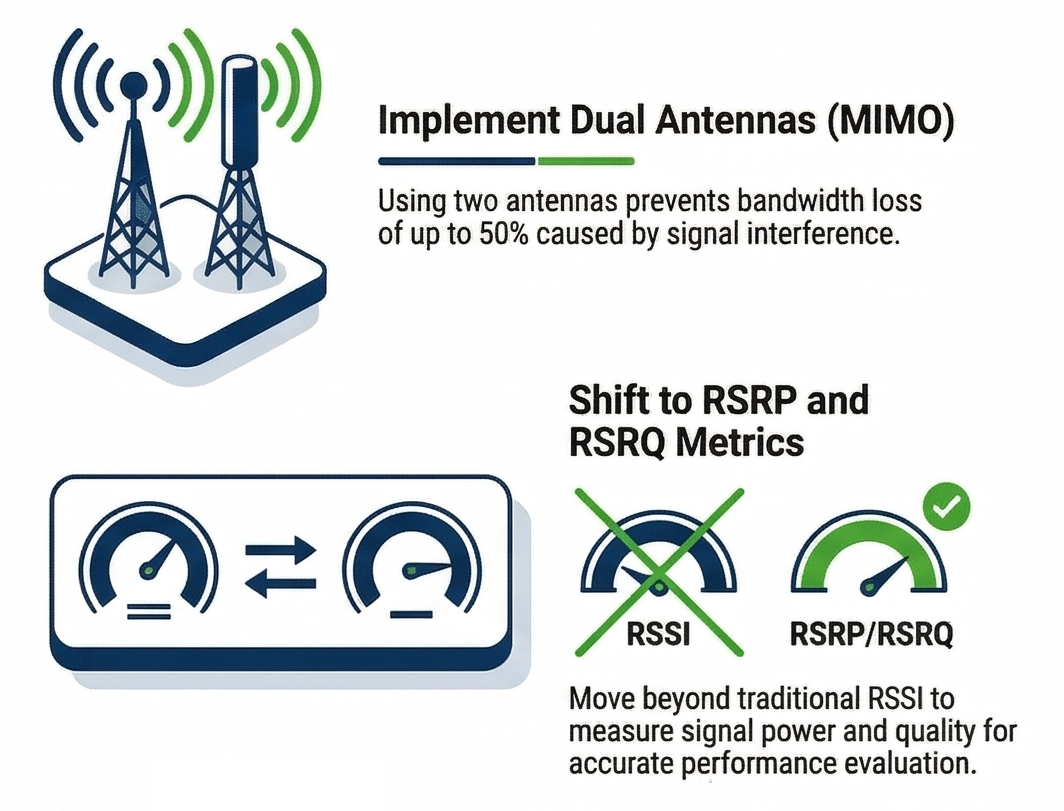
- Dual Antennas: While 3G networks used a primary antenna to transmit and a secondary to receive (“receive diversity”), 4G LTE utilizes Multiple Input/Multiple Output (MIMO) technology, where both antennas transmit and receive. Using a single antenna can cut bandwidth by up to 50 percent; dual antennas are considered a best practice for optimal performance.
- Evaluating Signal Quality: In older networks, Received Signal Strength Indicator (RSSI) was used to measure signal strength, but it failed to isolate signal noise. LTE introduces three superior metrics: RSRP (Reference Signal Received Power) for strength, RSRQ (Reference Signal Received Quality) for quality, and SINR (Signal to Interference and Noise Ratio) to measure channel throughput capacity.
- Real-World Speed Factors: While LTE is vastly faster than 3G, real-world speeds fluctuate based on distance from the cell site, physical obstructions, electromagnetic interference, antenna quality, and network load.
4. The Unified Global Standard: FDD and TDD
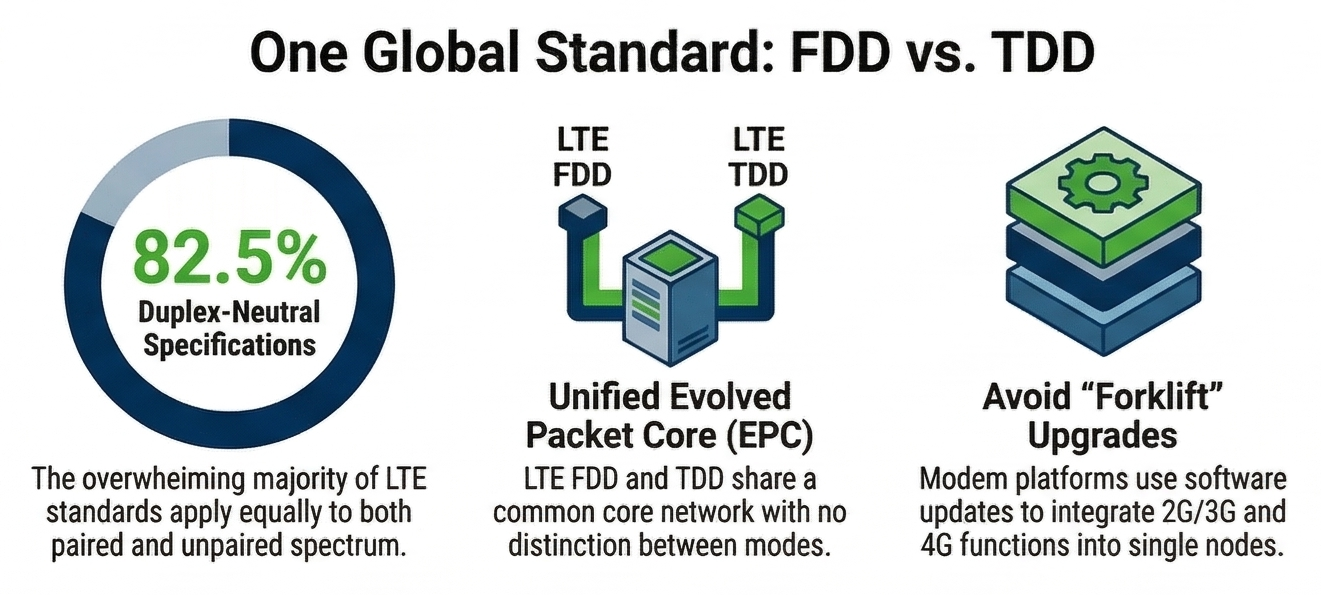
There is a common misconception that paired spectrum (LTE FDD) and unpaired spectrum (LTE TDD) are fundamentally different technologies. In reality, LTE is a single, unified global standard developed by organizations worldwide to operate in both spectrum bands with minimal complexity.
During the 3GPP standardization process, the overwhelming majority (82.5%) of the nearly 83,000 LTE submissions were duplex-agnostic, applying equally to both FDD and TDD. Only 3.7% of submissions were specific to LTE FDD, and 7.0% to LTE TDD. Organizations from Europe, the US, China, South Korea, and Japan actively contributed to this unified standard.
The core network (EPC) is completely agnostic to the choice of duplex scheme. The physical layers are also virtually identical—sharing the same subframe length of 1 ms, modulation types, MIMO implementations, and channel coding. The primary differences between FDD and TDD relate to when actions are executed, rather than how, due to the discontinuous nature of TDD’s shared downlink/uplink channel. To prevent technology fragmentation, the global community harmonized LTE TDD on a single frame structure (Frame Structure Type 2), deliberately removing similarities with older 3G TDD standards to ensure maximum compatibility with FDD.
5. Frequencies, Bands, and Deployment Flexibility
LTE was designed to provide ultimate flexibility, supporting varying spectrum allocations and technological starting points for operators worldwide. The specifications define scalable channel bandwidths of 1.4, 3, 5, 10, 15, and 20 MHz. This flexibility allows operators to deploy LTE in narrow bands when transitioning from legacy technologies, while utilizing wider channels in areas with abundant spectrum.
As of Release 10, the LTE specifications support 34 different frequency bands—23 FDD bands and 11 TDD bands—creating a massive 329 possible deployment configurations for TDD alone when factoring in variable bandwidths and downlink/uplink ratios.
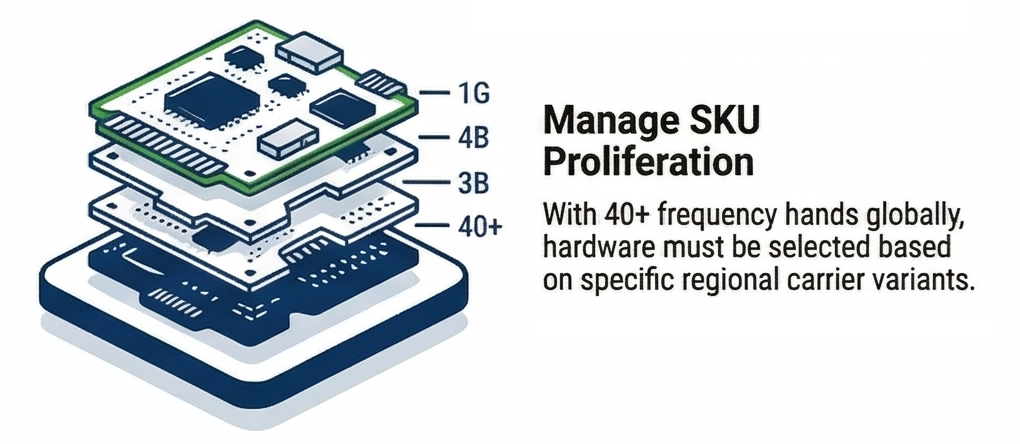
While lower frequencies offer better building penetration and larger service areas, and multiple bands allow for aggregated bandwidth, this proliferation presents distinct challenges. Because 4G LTE defines more than 40 bands globally, there is no longer an economically feasible single worldwide SKU for an LTE module. Devices must be manufactured in regional variants (e.g., Americas, Europe, APAC), requiring network operators to carefully match their hardware to the specific frequencies and bands supported by their local carriers. Despite this complexity in RF components, the underlying LTE standard remains universally identical, proving its success as a highly adaptable global architecture.