
DAS – Enhancing In-Building Connectivity with Distributed Antenna Systems
As mobile device usage density increases and building construction materials increasingly inhibit cellular signals, maintaining consistent and reliable connectivity has become a significant challenge for property owners and businesses. A Distributed Antenna System (DAS) is an in-building solution that enhances and distributes a cellular carrier’s signal throughout a facility, ensuring reliable, high-quality cellular connectivity. By overcoming the challenges posed by complex building layouts, structural interference, and high user density, DAS ensures seamless communication for 4G, LTE, and 5G networks. This white paper explores the concept, architecture, applications, implementation considerations, and key advantages of DAS technology.
1. Introduction to Distributed Antenna Systems
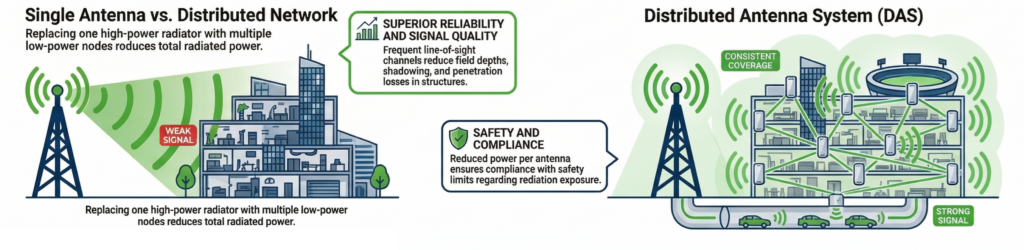
A Distributed Antenna System (DAS) is a network of spatially separated antenna nodes connected to a common source via a transport medium. The core concept, first described in 1987, involves splitting the transmitted power among several strategically placed antenna elements to provide coverage over an area that a single high-power antenna could not reliably reach.
This distributed approach works because less power is wasted overcoming penetration and shadowing losses, and a line-of-sight channel is present more frequently, which reduces fade depths. The DAS process typically involves four steps:
- Receiving the wireless signal from a carrier’s main tower or base station.
- Processing and amplifying the signal at a central equipment hub.
- Sending the enhanced signal through fiber optic or coaxial cables to remote antenna nodes placed around the venue.
- Broadcasting the signal via these remote units to mobile devices.
2. Types of DAS Architecture and Signal Sources
DAS networks can be configured using different architectures and signal sources to meet the specific size, density, and budget requirements of a facility.
DAS Architectures:
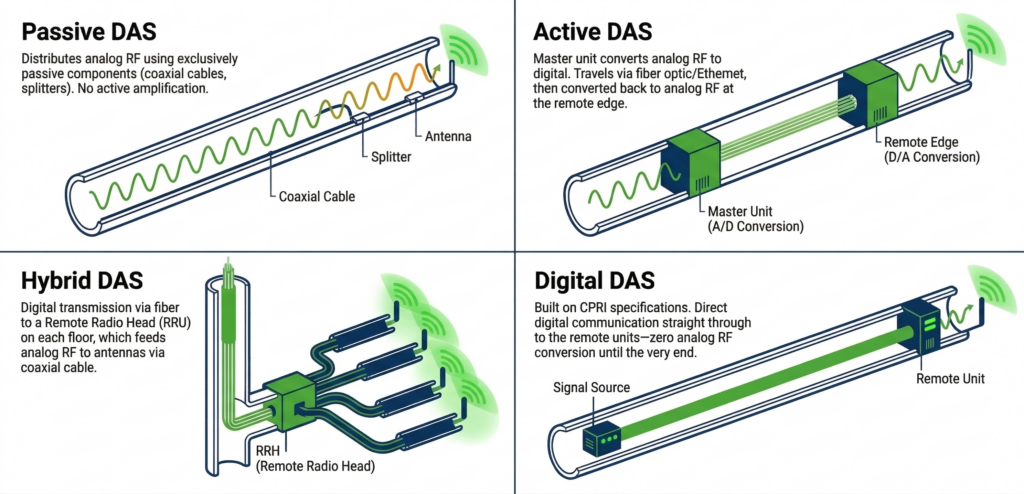
- Passive DAS: Uses non-powered RF components like coaxial cables, splitters, and couplers to distribute the signal. Passive DAS is highly cost-effective and carrier-agnostic, making it ideal for smaller buildings like schools or hotels.
- Active DAS: Converts the analog RF signal into a digital signal, distributing it via Ethernet or fiber optic cables to remote access units, which convert it back to RF for broadcast. This architecture results in virtually no signal loss, making it perfect for massive venues like stadiums, though it is more expensive and requires carrier coordination.
- Hybrid DAS: Combines both active fiber optic cables and passive coaxial components, often used in large areas to balance cost and performance.
- Digital DAS: Operates via a direct digital connection to the base band unit, communicating directly with remote units without analog RF conversion.
DAS Signal Sources:
- Off-Air (Donor) Antennas: Installed on the building’s exterior to capture existing signals from nearby cell towers.
- On-Site Base Transceiver Stations (BTS): Connect directly to a wireless carrier’s network via fiber optic cables, providing higher capacity and control, typically used in active DAS.
- Small Cells: Act as localized signal sources, balancing the cost-effectiveness of off-air antennas with the control of a BTS.
3. Use Cases and Applications
Modern building materials, such as reinforced concrete and energy-efficient Low-E (low-emissivity) glass, are notorious for blocking radiofrequency signals. DAS provides critical coverage and capacity in environments where these materials or sheer user density overwhelm traditional networks:
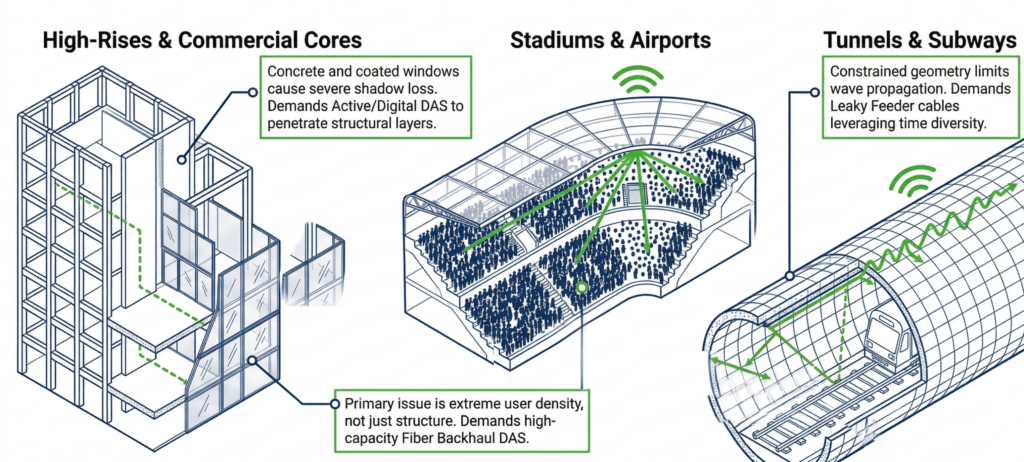
- High-Rises & Commercial Cores: Concrete reinforced structures and energy-efficient coated windows create severe signal attenuation, resulting in deep shadow loss. DAS solution helps penetrate these structural layers. This ensures seamless coverage in critical areas like building cores, basements, and high-speed elevators, improving both tenant satisfaction and public safety.
- Stadiums, Airports & High-Capacity Venues: When tens of thousands of users converge, the challenge is sheer capacity, not just structural blockage. This environment demands high-bandwidth solutions. DAS Solutions utilizes high-capacity Fiber Backhaul DAS to support immense user data and social media demand. Crucially, it provides the backbone for vital venue operations, including smart cameras, facial recognition security, and high-bandwidth mobile concessions.
- Tunnels & Subways: In long, narrow underground environments, the constrained geometry severely limits traditional wave propagation. To overcome these harsh conditions, DAS solutions using specialized Leaky Feeder cables helps leverage time diversity. This creates a virtual in-building solution for secure, private local networks, creating critical connectivity for transit operations, IoT sensors, and passenger safety monitoring.
4. Design and Implementation Considerations
When designing and implementing a DAS solution, the primary objective is to engineer a network that effectively addresses the environment’s specific challenges.
Key Design Factors:
- Demand & Density Constraints In environments defined by Extreme Density (e.g., Stadiums, Airports, Convention Centers), standard distribution systems fail under the sheer load of thousands of simultaneous users and high-bandwidth venue operations. These deployments prioritize capacity over all else
- Signal Penetration Constraints In large, modern commercial environments, the primary issue is penetration. Dead Zones are often caused by the severe signal attenuation from heavy concrete structures, metal shielding, and energy-efficient coated windows.
- Macro Network Constraints The availability and strength of the existing macro network determine the required solution architecture.
- Weak Outdoor Signal: When the base signal is already degraded, an in-building solution must generate its own clean network. Consideration: A Small Cell DAS deployment creates a secure, private local network that is entirely independent of poor outdoor signals.
- Strong Outdoor Signal: The focus is on distributing the existing high-quality signal effectively throughout the venue.
- Spatial Geometry Constraints: The physical layout of the venue dictates the final distribution media.
- Wide & Open Areas: These spaces are best served by broad, omnidirectional coverage. Consideration: The design should utilize an distribution system feeding Omni/Patch antennas.
- Narrow & Constrained Areas: Standard antennas fail in the extreme multi-path environments of long tunnels or narrow subways. This environment mandates the use of specialized antennas or leaky feeder cables to maintain constant, seamless signal along the entire path.
Summary
Distributed Antenna Systems (DAS) represent the most robust infrastructure for indoor wireless communication. By effectively bypassing structural barriers and actively distributing multi-carrier RF signals, DAS guarantees uninterrupted coverage and massive data capacity. Whether facilitating life-saving communications in hospitals, enabling digital transformations in manufacturing, or providing a seamless user experience in massive stadiums, investing in DAS is a critical step in future-proofing modern real estate and enterprise environments.