
IoT – Scalable Antenna Solutions for Global IoT Connectivity
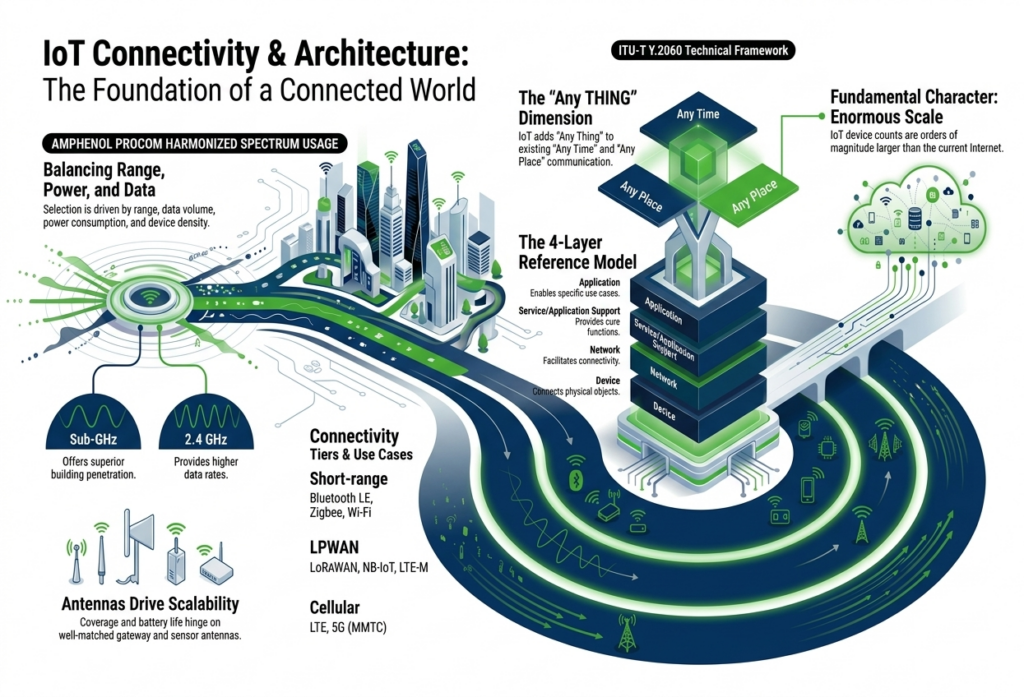
The Internet of Things (IoT) represents a global infrastructure for the information society, designed to enable advanced services by interconnecting physical and virtual objects. By seamlessly adding “Any THING communication” to the traditional paradigms of “any TIME” and “any PLACE” connectivity, the IoT transforms how data is collected, processed, and utilized across industries. This white paper explores the foundational principles of IoT, outlining its core reference architecture, the diverse landscape of wireless connectivity, and the specific advancements in Mobile IoT (MIoT) technologies such as NB-IoT and LTE-M. As deployments scale to millions of devices, achieving interoperability, maximizing battery life, and ensuring deep coverage are paramount. Through an analysis of standardized features like Power Saving Mode (PSM) and Extended Discontinuous Reception (eDRX), as well as emerging capabilities in 5G and massive IoT, this paper provides a comprehensive overview of how scalable IoT solutions are designed and deployed.
1. Introduction to the Internet of Things (IoT)
The IoT is a far-reaching vision with profound technological and societal implications. At its core, the IoT is a global infrastructure that interconnects things—objects of the physical world (capable of being sensed and actuated) or the virtual world (capable of being stored and processed)—using interoperable information and communication technologies (ICT).
Several fundamental characteristics define the IoT environment:
- Interconnectivity: Anything can be integrated into the global communication infrastructure.
- Heterogeneity: Devices are built on diverse hardware platforms and interact across various network types.
- Dynamic Changes: The state of devices (e.g., sleeping or waking up) and their environmental context continuously shift.
- Enormous Scale: The number of connected devices vastly exceeds human-operated devices on the traditional Internet, shifting the primary network load toward device-triggered communication.
To support this massive ecosystem, the IoT relies on several high-level requirements. These include identification-based connectivity, autonomic networking (to enable self-management and self-healing), strict security policies, and robust privacy protection to safeguard data during transmission, aggregation, and storage.
2. The IoT Reference Architecture
To standardize the development and deployment of IoT systems, the ITU-T defines a four-layer IoT reference model, accompanied by cross-layer management and security capabilities.
- Device Layer: This layer consists of the physical equipment interacting with the environment and the network. Devices must possess communication capabilities and may optionally feature sensing, actuation, or data capture functions. The device layer encompasses data-carrying devices (attached to physical things), data-capturing devices (readers/writers), sensing/actuating devices, and general devices (like smart home appliances). Gateway capabilities also reside here, allowing for protocol conversion and multi-interface support.
- Network Layer: This layer is responsible for transporting IoT service data and control information. It provides networking capabilities such as access control, mobility management, and authentication.
- Service Support and Application Support Layer: This layer provides common generic capabilities (like data processing and storage) that can be utilized by multiple IoT applications, alongside specific capabilities tailored to distinct use cases.
- Application Layer: The top layer houses the actual IoT applications, such as smart grids, e-health, and intelligent transportation systems.
Security and management capabilities—including fault, configuration, accounting, performance, and security (FCAPS)—span across all four layers to ensure robust and safe operation.
3. The IoT Connectivity Landscape
The IoT is not a single technology but a wide spectrum of wireless options chosen to balance range, data rate, power consumption, and cost. Broadly, IoT connectivity falls into three categories:
- Short-range: Technologies like Bluetooth LE, Zigbee, and Wi-Fi provide local connectivity.
- Low-Power Wide-Area (LPWAN): Solutions such as LoRaWAN, Sigfox, NB-IoT, and LTE-M prioritize long-range coverage and multi-year battery life at low data rates. They are ideal for smart metering, asset tracking, and environmental sensing.
- Cellular: Technologies like standard LTE and 5G accommodate higher data rates and mobility.
The choice of frequency band significantly impacts deployment. Sub-GHz bands (e.g., 868/915 MHz) offer superior range and deep building penetration, making them highly effective for LPWAN. In contrast, 2.4 GHz bands allow for higher data rates and smaller device antennas. Because IoT relies heavily on continuous coverage, the design of both base-station and device antennas is critical to the scalability and dependability of any deployment.
4. Mobile IoT: Optimizing Power and Coverage
Mobile IoT (MIoT) specifically refers to 3GPP-standardized cellular LPWA technologies operating in licensed spectrum, predominantly NB-IoT and LTE-M. These technologies are complementary and are often deployed side-by-side to serve the rapidly expanding IoT market globally.
To enable devices to operate in the field for up to ten years without battery replacement, MIoT relies on specialized baseline features:
- Power Saving Mode (PSM): PSM allows a device to drastically reduce power consumption (into the micro-Ampere range) by disabling parts of its chipset while remaining registered with the network. Devices wake up based on negotiated timers to send updates without needing to execute an energy-draining reattach procedure.
- Extended Discontinuous Reception (eDRX): Designed primarily for downlink-centric applications, eDRX allows a device to turn off its receiver circuitry for extended intervals (from several seconds to a few hours). It provides a valuable compromise between energy conservation and network reachability.
Additionally, MIoT introduces Coverage Enhancement (CE) features to reach devices in challenging environments, such as underground parking garages or remote terrain. CE works by increasing the power levels of signaling channels and repeating transmissions. LTE-M utilizes CE Mode A (up to +5dB enhancement, mandatory) and optionally CE Mode B (up to +15dB). NB-IoT supports three coverage levels (CE Level 0, 1, and 2), increasing the maximum coupling loss to up to 164dB.
5. Emerging Technologies and Future Enhancements
As IoT networks expand, continuous technological evolution ensures they can support a growing density of end-points. 5G Massive Machine-Type Communications (mMTC) is designed to scale to very high device densities, utilizing network slicing and edge computing for latency-sensitive industrial applications.
Simultaneously, the 3GPP standards continue to introduce new and emerging features to enhance LTE-M and NB-IoT efficiency:
- Wake-Up Signals (WUS): Rather than blindly decoding control channels to check for paging messages, devices can listen for a highly compact “wake-up signal”. If no WUS is detected, the device remains asleep, greatly reducing power consumption.
- Early Data Transmission (EDT): This feature allows an idle device to transmit small data payloads (up to roughly 100 bytes) during the initial random-access procedure. By skipping the transition to a fully connected mode, both signaling overhead and energy expenditure are minimized.
- Non-IP Data Delivery (NIDD): To simplify device design and reduce overhead, NIDD allows a device to transfer data without operating a full IP stack or acquiring an IP address, which is particularly beneficial for highly constrained NB-IoT sensors.
- VoLTE for LTE-M: While still an emerging capability in many markets, Voice over LTE is being adapted for LTE-M to support applications (like wearables) that require audio communication alongside low-power data transfer.
Summary
The Internet of Things encompasses an expansive and highly dynamic ecosystem, bridging the physical and digital worlds through an array of specialized devices, standardized reference models, and tailored wireless technologies. As deployments transition into the millions, the success of IoT heavily depends on maintaining the delicate balance between range, data throughput, power consumption, and hardware cost.
The maturation of Mobile IoT standards—specifically NB-IoT and LTE-M—has provided a critical foundation for scalable deployments. By leveraging licensed spectrum and implementing baseline power-saving and coverage-enhancing protocols like PSM, eDRX, and signal repetition, network operators can ensure ubiquitous, multi-year connectivity. Moving forward, the integration of Massive IoT within the 5G framework, along with emerging 3GPP features like Wake-Up Signals and Early Data Transmission, will further optimize network efficiency, paving the way for a more deeply interconnected and autonomic future.