FRMCS: The 5G Future of Railway Communication
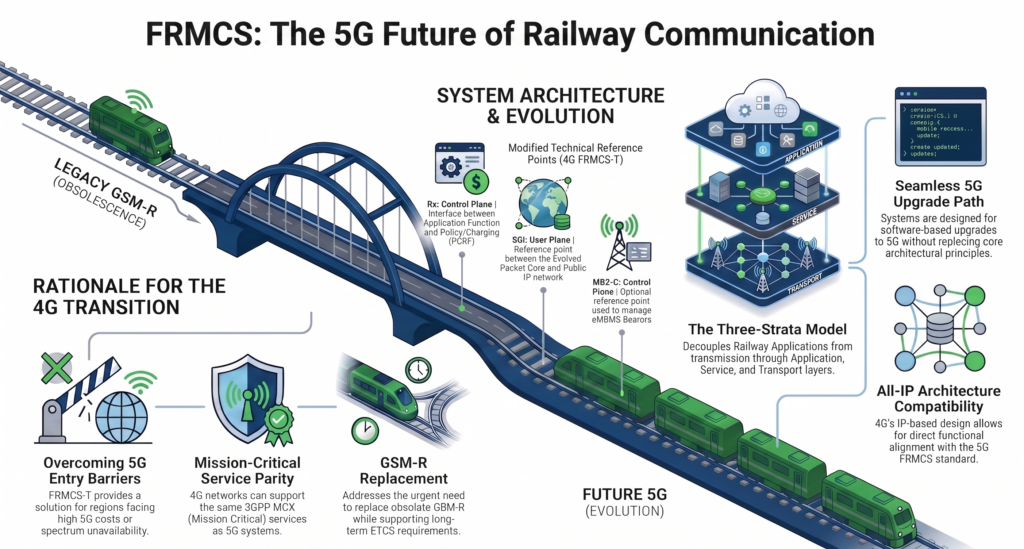
The Future Railway Mobile Communication System (FRMCS) is the next-generation worldwide telecommunication standard engineered to replace the legacy Global System for Mobile Communications-Railway (GSM-R). Developed by the International Union of Railways (UIC) in cooperation with the 3rd Generation Partnership Project (3GPP) and the European Telecommunications Standards Institute (ETSI), FRMCS is built on 4G LTE and 5G New Radio (NR) foundations. It is designed to act as a crucial enabler for railway digitalization, delivering mission-critical voice, high-throughput data, and video capabilities. By adopting a transport-agnostic application layer, FRMCS allows railways to utilize standard cellular technology rather than a bespoke network, ensuring interoperability, support for Automated Train Operation (ATO), and a technological lifespan expected to exceed three decades.
1. The Impetus for Change and the Need for FRMCS
For over two decades, GSM-R has been the foundational operational communication network for railways, currently deployed on more than 130,000 kilometers of track in Europe and 210,000 kilometers worldwide. However, the railway sector faces two pressing strategic challenges that necessitate a technological leap:
- Impending Obsolescence: GSM-R is a 2G-based system facing imminent obsolescence. The end of support for GSM-R is widely expected between 2030 and 2035, posing a global risk to the continuity of the European Railway Traffic Management System (ERTMS).
- The Demand for Digitalization: The evolution of ERTMS involves introducing “Game Changers” such as ATO, optimized braking curves, ETCS Level 3, and enhanced train positioning. These innovations require the transmission, reception, and processing of increasingly large volumes of data, which the narrow bandwidth of GSM-R cannot support.
FRMCS addresses these challenges by serving as the vital communication enabler for these digital advancements, supporting the future of sustainable and automated rail transport.
2. Architecture and 3GPP Standards
Unlike GSM-R, which relied on bespoke railway telecommunication modifications, FRMCS is deeply integrated into mainstream 3GPP standards, particularly utilizing Mission-Critical (MCX) services.
- Standardized Mission-Critical Capabilities: Built on 3GPP Releases 15 through 17 (under the “MONASTERY” series of Work Items), FRMCS supports Mission Critical Push To Talk (MCPTT), Mission Critical Data (MCData), and Mission Critical Video (MCVideo). These services provide group and priority voice with fast call set-up, pre-emption, and guaranteed Quality-of-Service (QoS).
- Decoupled Strata Architecture: To ensure independence between railway applications and physical transmission, the FRMCS architecture is divided into three main strata: the Railway Application Stratum, the Service Stratum, and the Transport Stratum. This decoupling ensures that the evolution of transport networks (such as upgrading from 4G to 5G) does not force disruptive changes to the railway applications themselves.
- High-Speed Mobility Adaptations: 3GPP standards have been heavily modified to support devices moving at extreme speeds. FRMCS integrates specifications ensuring reliable radio resource management and signal demodulation for high-speed trains traveling up to 500 km/h.
3. Dedicated Spectrum and Radio Capabilities
A robust communication system requires dedicated and reliable spectrum. FRMCS is designed to operate flexibly across several frequency bands, optimizing both capacity and coverage:
- CEPT-Harmonized Railway (RMR) Spectrum: In Europe, FRMCS will utilize paired 900 MHz FDD bands (874.4-880.0 / 919.4-925.0 MHz)—sharing space with GSM-R during the transition phase—and unpaired 1900-1910 MHz TDD (5G NR band n101) for additional capacity.
- High-Band Utilization: For high-throughput applications such as CCTV, diagnostics, and telemetry, FRMCS can utilize higher frequency bands, such as n78 (3.7 GHz).
- Flexible Access: The system enables the simultaneous use of multiple frequency bands (Multi Access) and can seamlessly support licensed railway spectrum alongside public Mobile Network Operator (MNO) spectrum and non-3GPP frequencies like Wi-Fi.
4. FRMCS-Transition (FRMCS-T) for Global Accessibility
While the primary target for FRMCS is 5G, the UIC recognizes that some regions worldwide may face hurdles in accessing 5G technologies due to spectrum costs, national development schedules, or early migration constraints. To address this, the UIC developed the FRMCS-Transition (FRMCS-T) technical guideline.
- 4G LTE Applicability: FRMCS-T facilitates the application of FRMCS over 4G Evolved Packet System (EPS) networks. Because 4G has an all-IP architecture very similar to 5G, many 4G devices can provide Mission Critical services (standardized since 3GPP Release 13) and can be upgraded to 5G later via software or module changes.
- System Integrity: FRMCS-T strictly adheres to the same Application and Service strata principles as the 5G version, substituting only the 5G core and radio access with 4G equivalents. It maps necessary 5G Quality of Service requirements (5QI) directly to 4G QoS Class Identifiers (QCI) to maintain latency and packet reliability.
- Cybersecurity: FRMCS-T employs stringent 4G cryptographic algorithms (such as 128-EEA1 for confidentiality and 128-EIA1 for integrity) to authenticate subscriptions and protect both user and signaling data.
5. Migration Roadmap and Interoperability
Transitioning a continent’s rail network to a new communication standard is a complex undertaking that requires extensive planning.
- Migration Timeline: The European migration from GSM-R to FRMCS is planned to take place between 2025 and 2035. National programs, such as Deutsche Bahn (2026-2035) and SNCF/SBB (targeting a 2035 switch-off), are already underway.
- Dual-Running Period: A lengthy transition period is mandated where GSM-R and FRMCS will operate concurrently (referred to jointly as Railway Mobile Radio Systems – RMR). This dual-running phase ensures that mission-critical reliability is fully validated before GSM-R is finally retired.
- Project MORANE 2 and Future Readiness: To finalize the standard, operational testing of FRMCS functions and systems is being conducted through multi-national test beds, notably the FP2-MORANE-2 project. Running for 34 months, this project aims to deliver market-ready “V3 Specifications” (the FRMCS 1st Edition) for inclusion in the 2027 Control-Command System Technical Specification for Interoperability (CCS-TSI), initiating full-scale European deployments.
Summary
The Future Railway Mobile Communication System represents a paradigm shift for railway telecommunications, moving the industry from the aging 2G technology of GSM-R into the high-performance era of 4G LTE and 5G NR. By leveraging universally adopted 3GPP mission-critical standards and establishing a decoupled architecture, FRMCS guarantees long-term sustainability, cross-border interoperability, and the bandwidth necessary for Automated Train Operation. Through thoughtful transition frameworks like FRMCS-T and a meticulously planned dual-running migration window extending to 2035, the rail sector is ensuring a secure, reliable, and deeply integrated digital future for global rail transport.