
SCADA: Wireless Telemetry Solutions for Industrial Connectivity
SCADA (Supervisory Control and Data Acquisition) systems are critical for monitoring and controlling distributed industrial processes, including power grids, water networks, and oil and gas pipelines. Because many of these industrial assets are remote and unmanned, highly dependable wireless telemetry is essential to gather sensor data and issue control commands reliably. This white paper explores the architectural components of SCADA systems, the wireless telemetry bearers that facilitate communication, antenna infrastructure considerations, core industrial protocols, and the vital role of cybersecurity in protecting operational technology (OT) infrastructure.
1. Introduction to SCADA Systems
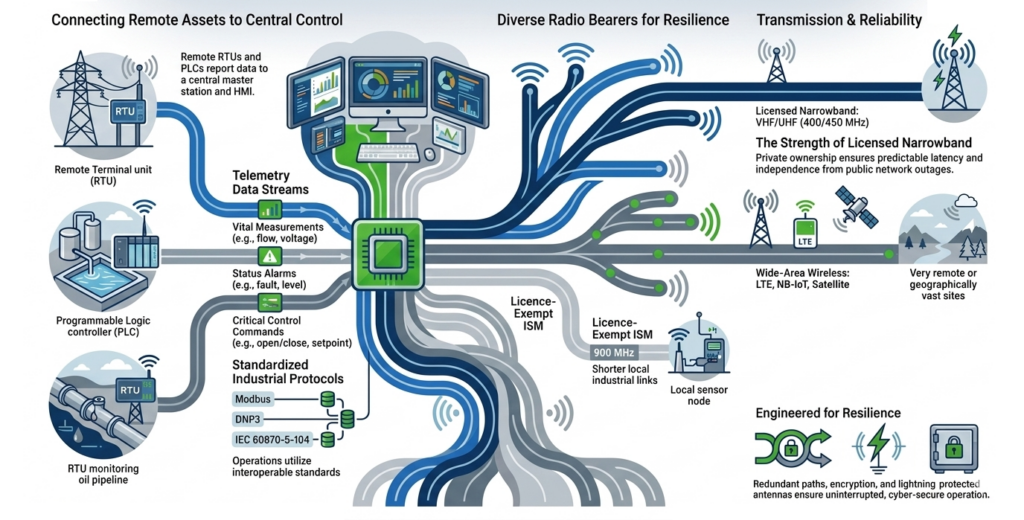
SCADA systems form the operational backbone of modern critical infrastructure by keeping widespread and remote assets observable and controllable. At the edge of the network, remote Remote Terminal Units (RTUs) and Programmable Logic Controllers (PLCs) are deployed to interface directly with industrial equipment. These remote devices report back to a central master station and a Human Machine Interface (HMI). The telemetry data transmitted across this architecture covers essential system measurements, critical alarms, and remote control commands.
2. Communication Bearers and Wireless Telemetry
A variety of radio bearers are utilized to carry SCADA traffic, with the choice often depending on the distance, terrain, and required reliability of the remote site.
- Licensed Narrowband Data Radio: Operating on VHF/UHF frequencies (e.g., 400/450 MHz), this legacy technology provides long-range, interference-protected links. Narrowband endures as a mainstay for low-data telemetry because of its high reliability, predictable latency for control-critical applications, and private ownership, which allows operators to avoid dependence on public networks.
- Licence-Exempt ISM: Frequencies such as 900 MHz are typically used for shorter, local communication links.
- Cellular and Satellite: Technologies like LTE, LTE450, NB-IoT, and satellite communications are increasingly used to complement narrowband, providing wide-area reach for very remote sites.
3. Telemetry Infrastructure and Site Considerations
To maintain the continuous links that utility and industrial controls depend upon, resilient site design and reliable antenna infrastructure are central to uninterrupted operation. Engineers must carefully select between directional antennas, such as Yagi antennas, and omnidirectional antennas, ensuring they are perfectly matched to the specific link geometry. To close long telemetry links effectively, correct antenna gain and precise alignment are required.
Because SCADA stations are designed for continuous, unattended operation, robust outdoor antennas, lightning protection, and proper RF filtering are necessary at remote stations. Furthermore, network resilience is achieved by designing redundant communication paths, utilizing store-and-forward mechanisms, and deploying repeaters to extend coverage and reliability.
4. Core SCADA Protocols
Industrial protocols run over the chosen radio bearers to ensure interoperability between devices. Key standards include:
- DNP3 (IEEE 1815): The Distributed Network Protocol (DNP3) is an open, public protocol developed to achieve standards-based interoperability between substation computers, RTUs, Intelligent Electronic Devices (IEDs), and master stations. First adopted as IEEE Std. 1815 in 2010, its application levels range from simple low-cost distribution feeder devices to complex, full-featured master stations. It is widely used in the electric utility, water/wastewater, transportation, and oil and gas industries.
- IEC 60870-5-104: This international standard defines a telecontrol companion standard using standard transport profiles for coded bit serial data transmission. It enables interoperability for monitoring and controlling geographically widespread processes and is of high relevance for the Smart Grid.
- Modbus: Another prevalent industrial protocol that routinely runs over SCADA radio bearers to manage communication between connected industrial devices.
5. Cybersecurity in Operational Technology (OT)
As SCADA networks grow more interconnected, there is a growing emphasis on cyber-secure links and encryption for critical-infrastructure protection. The National Institute of Standards and Technology (NIST) provides comprehensive guidance in SP 800-82 Rev. 3, Guide to Operational Technology (OT) Security. This guide addresses how to secure OT—which encompasses programmable systems like SCADA, Distributed Control Systems (DCS), and PLCs that interact with the physical environment—while accommodating their unique performance, reliability, and safety requirements.
In addition to physical network security, protocol-level security is advancing. For instance, the DNP Users Group provides specific guides on implementing secure authentication and integrating Zero Trust Architectures into DNP3 environments. Deploying recommended security countermeasures mitigates the risks associated with common threats and vulnerabilities to these vital systems.
Summary
SCADA systems make it possible to monitor and manage vast, distributed industrial assets efficiently. The success of these systems relies heavily on dependable wireless telemetry, where traditional licensed narrowband radio continues to play a pivotal role alongside modern cellular and satellite networks. By combining robust physical infrastructure, standardized interoperable communication protocols like DNP3 and IEC 60870-5-104, and rigorous OT cybersecurity frameworks, operators can ensure that global critical infrastructure remains resilient, secure, and continuously operational.