
HF – Advanced HF Radio Propagation and Communications Systems
High-Frequency (HF) radio technology is currently experiencing a profound strategic resurgence, positioning itself as a primary pillar of modern, resilient communication architectures. As satellite constellations face increasing congestion, astronomical operational costs, and escalating vulnerabilities to kinetic and electronic interference, HF offers a sophisticated, infrastructure-independent alternative. For the strategic architect, HF is no longer a legacy “backup” but a high-performance medium capable of ensuring global C2 (Command and Control) in contested A2/AD (Anti-Access/Area Denial) environments.
The modern HF ecosystem has transitioned from manual, operator-dependent systems to cognitive, wideband architectures. This evolution provides three decisive strategic advantages:
- Contested Environment Resilience: Unlike SATCOM, HF is notoriously difficult to jam or locate due to its inherent propagation properties and the integration of advanced ECCM (Electronic Counter-Countermeasures).
- Infrastructure-Free Global Reach: Leveraging ionospheric reflection, HF sustains trans-continental links without reliance on vulnerable terrestrial relays or orbital assets.
- Cognitive Agility: Digital Signal Processing (DSP) and “Ideal Software Radio” architectures now allow for autonomous frequency management, wideband data rates up to 300 kbit/s, and rapid link establishment.
1. The Fundamentals of HF Propagation
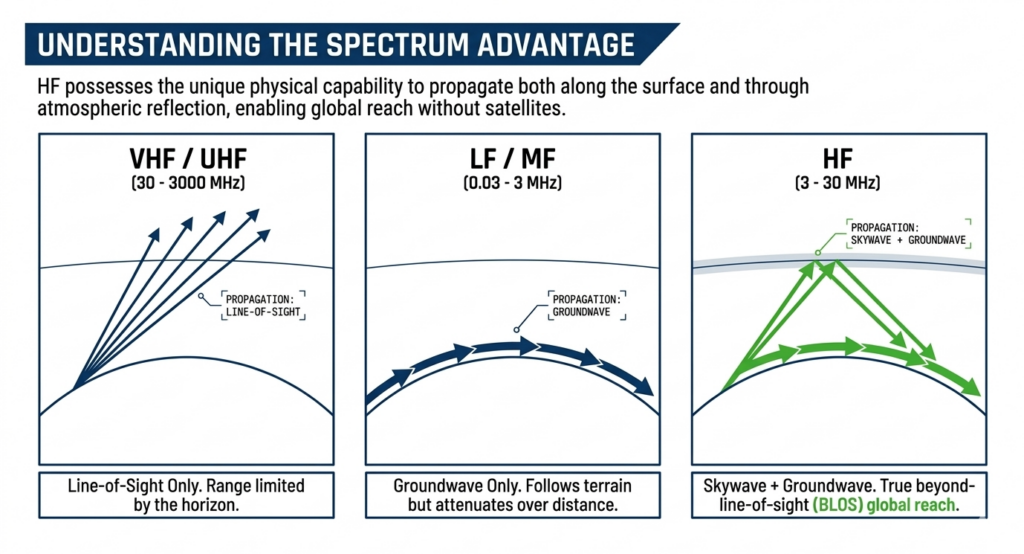
Sustaining reliable long-distance links requires a sophisticated understanding of the interaction between radio waves and the ionospheric engine. Unlike the line-of-sight (LOS) limitations of VHF/UHF, HF utilizes three core propagation modes to achieve specific operational objectives.
Primary Propagation Modes
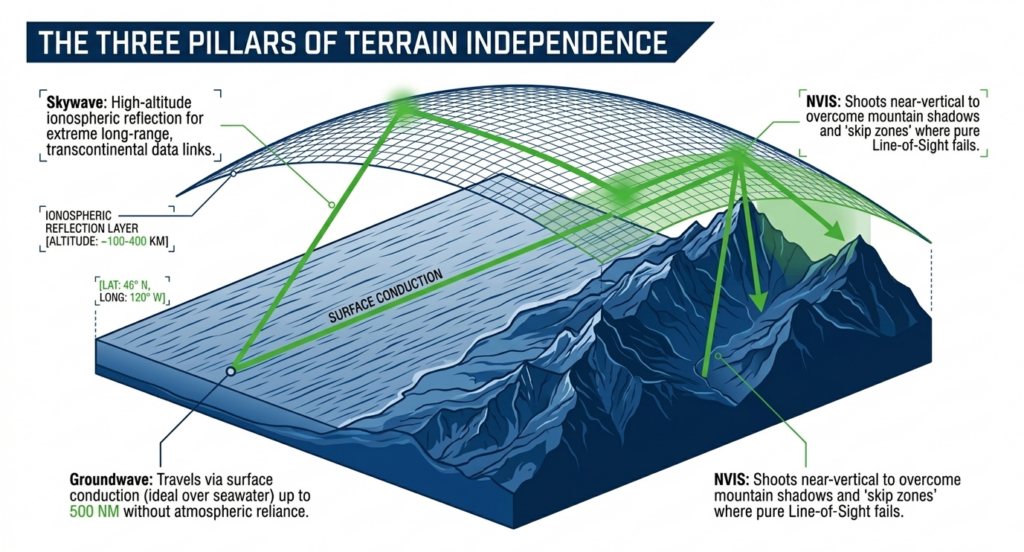
- Skywave Propagation: Often termed “space wave” propagation, this mechanism treats the ionosphere as a natural satellite. By reflecting signals off atmospheric layers, HF can bridge thousands of kilometers, enabling trans-oceanic and inter-continental communication.
- Groundwave Propagation: Signals travel along the Earth’s curvature, interacting electrically with the surface. This mode provides stable, medium-range connectivity (up to 500 NM over sea), independent of ionospheric shifts, making it ideal for maritime operations beyond the reach of coastal VHF.
- Near Vertical Incidence Skywave (NVIS): By transmitting signals nearly vertically, operators can bounce waves back to a localized area. This “straight up” technique is the definitive solution for overcoming “skip zones” and establishing connectivity in obstructed environments like deep forests or mountainous terrain.
2. HF in the Modern Strategic Landscape
In the current multi-domain operational environment, HF provides a terrestrial layer of resilience that cannot be matched by satellite or cellular infrastructure.
HF vs. SATCOM
| Criteria | HF (High Frequency) | SATCOM (Satellite) |
| Infrastructure | Infrastructure-Free; minimal hardware | High (Vulnerable orbital/ground assets) |
| Operating Costs | Near-Zero | High (Subscription/Lease costs) |
| Electronic Warfare | High resilience; difficult to jam/locate | High vulnerability to jamming/spoofing |
| Security | Inherent COMSEC/TRANSEC capabilities | Vulnerable to transit/uplink detection |
| Bandwidth | Wideband up to 48 kHz | Very High (but often congested) |
The Infrastructure-Free Advantage
HF is the sole medium capable of sustaining long-haul C2 in “Empty Zones”—the vast deserts, polar regions, and deep oceans where satellite coverage is either absent, saturated, or compromised. Its lack of reliance on base station networks or orbital relays makes it highly scalable and immune to the failure of public or commercial infrastructure.
PACE Strategy and Multi-Domain Resilience
Within a PACE (Primary, Alternate, Contingency, and Emergency) communications plan, HF has moved from the “Emergency” tier to the vital “Alternate” or “Contingency” layer. In A2/AD theaters, where primary satellite links may be disabled by solar events or adversarial EPM (Electronic Protective Measures), HF ensures that naval, land, and air forces remain synchronized.
3. The Technological Evolution: From Legacy to Cognitive HF
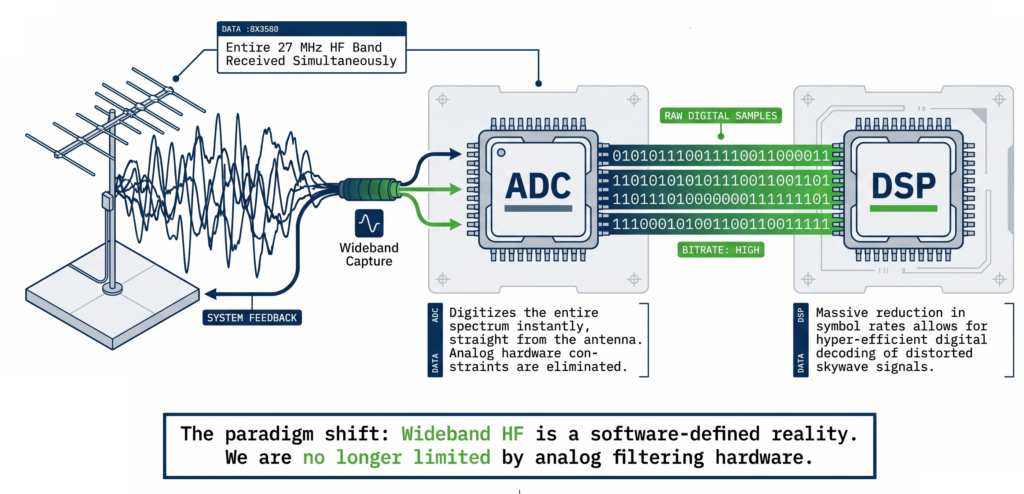
To unlock HF’s potential, the industry has transitioned from hardware-limited radios to adaptive, software-defined architectures.
The Performance Gap: Legacy vs. Cognitive
Legacy systems (2G/3G ALE*) were limited by manual channel planning and slow automation. While 3G ALE introduced some speed, it required rigid GPS time-synchronization and suffered from link setup times of up to 5 seconds. Modern Cognitive ALE has reduced this to a staggering 0.5 seconds—a 10x performance delta that enables the stability required for internet-grade services.
*[ALE, which stands for Automatic Link Establishment, is a protocol developed during the 1980s and 1990s to simplify High Frequency (HF) radio communications. Its primary function is to automatically initiate and maintain a common HF channel between a transmitter and a receiver. By automating this process, ALE significantly reduces the need for highly trained radio operators who previously had to manually rely on their ears and experience to select working HF channels.]
The “Ideal Software Radio” Revolutione
Modern systems distinguish between standard Software Defined Radio (SDR) and Ideal Software Radio. While standard SDRs still rely on analog signal processing stages, an Ideal Software Radio utilizes high-performance Analog-to-Digital Converters (ADCs) to digitize the entire HF band directly from the antenna. This allows for:
- Real-time Band Monitoring: Simultaneous monitoring of the spectrum to identify interference and noise floors.
- Autonomous Frequency Selection: Cognitive algorithms that find and switch to operational channels in milliseconds to avoid congestion.
- Adaptive Signal Processing: More efficient decoding of distorted skywave signals through superior DSP power.
Wideband HF Throughput
The shift from 3 kHz legacy channels to 48 kHz Wideband HF has fundamentally changed data expectations. By utilizing improved modems and cognitive management, modern systems achieve throughput rates of up to 300 kbit/s, facilitating IP-based traffic such as tactical chat, email, and situational awareness data.
4. Hardware Optimization and Antenna Performance
Antenna dynamics remain the physical bottleneck of any HF system. Strategic architects must account for the relationship between electrical length and efficiency.
Antenna Dynamics and Efficiency
For whip and monopole antennas, radiation resistance decreases rapidly at lower frequencies. This necessitates the use of antenna tuners which, while providing impedance matching, introduce insertion losses. This explains the drastic gain drop at the lower end of the spectrum.
Approximate Gain (dBi) vs. Frequency (MHz)
| Frequency (MHz) | 5m Antenna (HF 5000) Gain (dBi) | 7.5m Antenna (HF 7500-3) Gain (dBi) |
| 0.1 (Receive Only) | -50 | -45 |
| 0.4 (Receive Only) | -32 | -28 |
| 0.8 (Receive Only) | -25 | -21 |
| 1.6 | -18 | -15 |
| 3.2 | -11 | -7 |
| 6.4 | -4 | 0 |
| 10.0 | 0 | 4 |
| >20.0 | 4 | 5 |
The 7.5m antenna (HF 7500-3) delivers consistently higher gain than the 5m antenna (HF 5000) across the entire frequency range. The difference is modest at low frequencies but becomes more pronounced above ~3 MHz, reaching up to 4–5 dB improvement at higher frequencies. This results in better efficiency and overall performance, particularly in the upper HF band.
5. Critical Use Cases and Global Applications
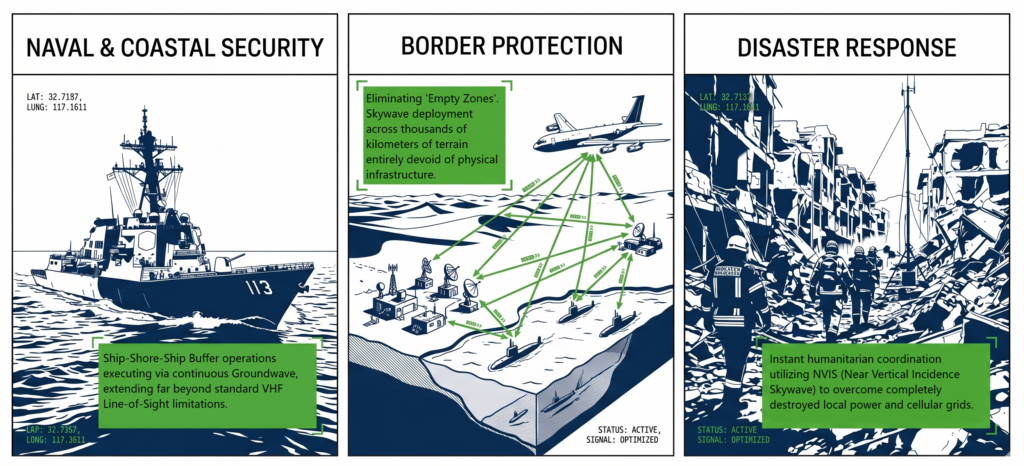
Naval & Coastal Security: The SSSB and Link 22: HF is the backbone of the Ship-Shore-Ship Buffer (SSSB), a real-time system for exchanging data between naval forces and airborne assets. The SSSB manages legacy Link 11 and Link 11B data while transitioning to the modern Link 22 (NATO Improved Link Eleven) standard. Link 22 enables a common operational overview across air, surface, and sub-surface elements, maintaining encrypted tactical links up to 1,000 NM.
National Backbone and: Governments deploy HF as a stand-alone backbone for embassy networks and strategic command. It serves as the primary C2 link between ground stations and submarines or fixed-wing aircraft. In customs and border protection, HF enables the long-range inspection of vessels at sea and the patrolling of unmonitored land borders where cellular coverage is non-existent.
Humanitarian Resilience and Army Aviation: In disaster scenarios where the power grid and SATCOM fail, HF remains the definitive survival medium. It is utilized for community-based environmental alerts and critical Army Aviation support for aeromedical evacuations. Its performance in extreme environments—from Antarctica to dense rainforests—ensures that first responders remain connected when all other networks are “blacked out.”
Summary
High-Frequency communication has evolved from a “forgotten medium” into a cognitive, software-defined pillar of global resilience. By overcoming the limitations of legacy ALE through Ideal Software Radio architectures and wideband processing, modern HF provides a robust, infrastructure-free alternative to SATCOM.
For the strategic decision-maker, the mandate is clear: Cognitive HF must be integrated as a mandatory layer of the PACE plan. Mastering these advanced propagation techniques, combined with 0.5-second link establishment and wideband data rates, ensures that C2 remains uninterrupted across any distance, terrain, or contested environment. HF is not just a link to the past; it is the most resilient path to a secure, multi-domain future.