
LTE 450: The Resilient Backbone for Critical Infrastructure and Mission-Critical IoT
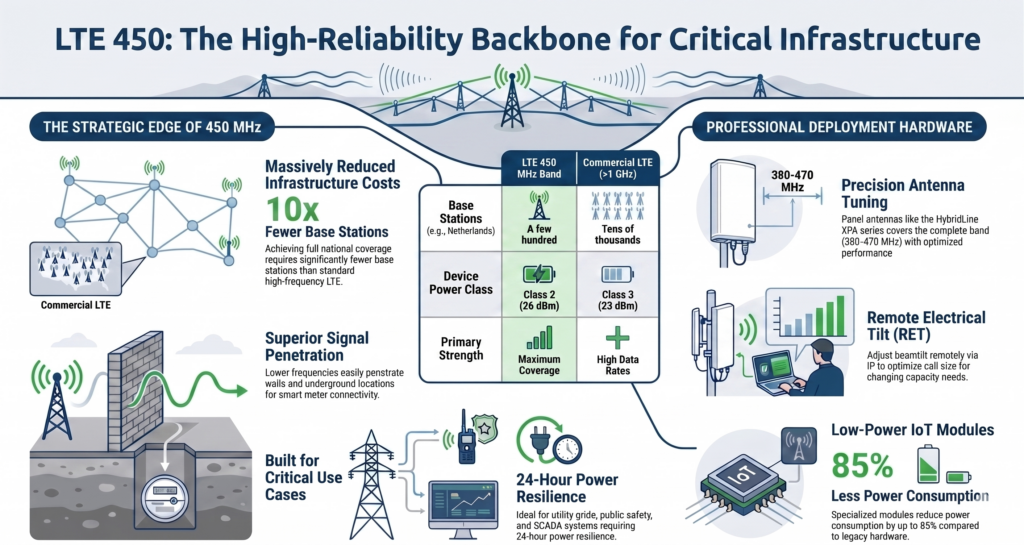
LTE 450 represents the “renaissance” of the 380-512 MHz spectrum. Once the domain of legacy analog and CDMA systems, this band is undergoing a technological revitalization, offering a unique combination of superior propagation physics and 4G/5G performance. For critical infrastructure operators, LTE 450 provides deep signal penetration and specialized resilience that commercial high-frequency networks simply cannot replicate.
The global adoption of LTE 450 is primarily driven by three critical industries:
- Utilities: Enabling the mandatory 24-hour operational resilience for smart grids and the management of millions of network elements across gas, water, and heat distribution.
- Public Safety: Providing privileged, non-congested access for Public Protection and Disaster Relief (PPDR) and emergency response coordination.
- Transportation: Securing robust, nationwide connectivity for logistics, railways, and road services in both urban and remote environments.
1. Understanding LTE450: Technology and Spectrum Fundamentals
1.1. Technical Definition and Evolution
LTE 450 is the deployment of standardized 4G Long-Term Evolution technology within the 380-512 MHz frequency range. This shift marks a transition from narrow-band legacy systems (analog and CDMA 450) to high-throughput, data-capable infrastructure. By leveraging these lower frequencies, operators can maintain the massive range of legacy systems while delivering the modern data rates required for mission-critical IoT.
1.2. 3GPP Standardized Bands
The 3GPP has assigned specific bands to the 400 MHz range to facilitate international standardization and hardware compatibility.
1.2. 3GPP Standardized Bands
The 3GPP has assigned specific bands to the 400 MHz range to facilitate international standardization and hardware compatibility.
| 3GPP Band | Uplink (MHz) | Downlink (MHz) | Suggested Status |
| Band 31 | 452.5–457.5 | 462.5–467.5 | Widely deployed LTE450 band, especially for utilities, critical infrastructure, and rural broadband. |
| Band 72 | 451–456 | 461–466 | Limited but active deployments; gaining interest for utility and critical communication networks. |
| Band 73 | 450–455 | 460–465 | Defined by 3GPP but very limited commercial deployment. |
| Band 87 | 410–415 | 420–425 | Intended for PMR/critical communications; deployments remain limited and region-dependent. |
| Band 88 | 412–417 | 422–427 | Intended for PMR/critical communications; deployments remain limited and region-dependent. |
1.3. Network Options
LTE 450 supports a versatile array of 4G protocols, ensuring the network can handle everything from simple sensors to high-bandwidth gateways:
- LTE-M (Cat M1): The current industry focus for low-power, wide-area critical IoT.
- NB-IoT (Cat NB1/NB2): Optimized for massive sensor density and extreme signal penetration.
- LTE Cat 1 / Cat 1bis: Delivering sustainable medium data rates (10 Mbps DL / 5 Mbps UL) for routers and concentrators; expected to secure a significant market share.
1.4. Enhanced Power Classes
To maximize the inherent range of the spectrum, 3GPP allows LTE 450 devices to utilize Power Class 2 (26 dBm) in addition to the standard Power Class 3 (23 dBm). This allows devices to effectively “shout louder,” ensuring a stable connection from obstructed or remote locations where standard commercial devices would fail to reach the base station.
2. The Physics of advantage Coverage, Penetration and Efficiency
2.1. Superior Propagation and Range
Sub-GHz signals offer a massive range advantage over commercial LTE (1 GHz+) and 5G (up to 39 GHz). According to u-blox, the coverage area of an LTE 450 base station is almost three times better than that of a station operating at 850 MHz.
2.2. Deep Signal Penetration
The lower the frequency, the lower the signal attenuation through solid objects. LTE 450 excels at reaching:
- Indoor Environments: Smart meters located deep within building interiors.
- Underground: SCADA sensors in basements or utility tunnels.
- Rural Environments: Assets spread across difficult, forested, or mountainous terrain.
2.3. Cost and Operational Efficiency
The deployment economics of LTE 450 are significantly more favorable for nationwide coverage compared to high-frequency commercial alternatives.
Commercial LTE vs. LTE 450 Comparison:
- CAPEX (Network Density): A country the size of the Netherlands requires tens of thousands of commercial LTE base stations, whereas LTE 450 achieves full geographical coverage with only a few hundred stations.
- OPEX (Leasing & Maintenance): Commercial networks face high ongoing costs due to site-leasing and energy requirements for thousands of nodes. LTE 450 minimizes these costs through a vastly reduced site count.
- Infrastructure Management: Fewer base stations allow for more robust management, making it easier to monitor and secure the network against physical and cyber threats.
2.4. Power Consumption
LTE 450 provides “blanket coverage,” eliminating the need for IoT devices to perform energy-draining repeated connection attempts. By ensuring a reliable connection on the first try, devices can spend more time in Power Save Mode (PSM), significantly extending the field life of battery-operated assets.
3. Global Deployment and Regulatory Landscape
3.1. Regional Adoption Status
LTE 450 is seeing aggressive deployment across Northern Europe (the Nordics), South America (Brazil), Africa, Indonesia, and the Middle East. Early adopters like the Netherlands, Poland, Ireland, the Czech Republic, and Estonia have already moved past trials into operational deployments.
3.2. The Case of Germany
In a landmark regulatory shift, German authorities awarded the 450 MHz spectrum specifically to the energy sector. This dedicated allocation provides the backbone for millions of network elements, including transformers, transport nodes, and smart meter gateways, ensuring they remain independent of commercial traffic.
3.3. Market Projections
Data from SNS Telecom & IT illustrates a rapidly maturing market:
- Past Milestones: Annual investments in public safety LTE/5G-ready infrastructure surpassed US$2 billion by the end of 2020.
- Future Growth: The market reached a projected US$3 billion by the end of 2023, growing at a CAGR of 10%.
- Market Share: As of Q2 2020, sub-500 MHz frequencies accounted for 17.31% of all public safety LTE/5G engagements.
3.4. Spectrum Allocation Trends
There is a global movement toward technology-agnostic allocations. This allows operators to replace legacy CDMA footprints with 4G/5G standards without requiring new spectrum licenses, facilitating a seamless transition to private networks that can be protected by dedicated firewalls against cyberattacks.
4. Mission-Critical Use Cases in Critical Infrastructure
4.1. Power Grid and Utilities Resilience
European mandates require critical communication networks to remain operational for at least 24 hours during a power failure. Because an LTE 450 network consists of a manageable number of base stations, it is far more feasible to equip the entire network with high-capacity backup batteries than it would be for a dense commercial network.
4.2. SCADA and Smart Metering
LTE 450 connects millions of smart meters and tens of thousands of SCADA systems. In Poland, the 450 MHz range is specifically utilized to connect measuring points and monitor wind turbines and other renewable energy assets across vast areas.
4.3. Public Protection and Disaster Relief (PPDR)
Emergency responders require privileged access to bandwidth. LTE 450 provides a dedicated environment free from the congestion of mass-market consumer services, ensuring voice and high-resolution video streaming remain available during major disasters.
4.4. Diverse Industrial IoT Applications
- Automation: Autonomous Ground Vehicles (UGV), drones (UAV), and connected factory machinery.
- Smart Cities: Traffic control systems and public distribution networks for gas, heat, and water.
- Healthcare: Connected healthcare systems and personal wearables for monitoring vulnerable individuals.
5. The Hardware Ecosystem: Amphenol Procom Solutions
A resilient LTE 450 network is only as strong as its RF components. While the internal device stack relies on multi-mode LPWA modules (such as the u-blox SARA-R540S or Quectel BG95-M4) to support “last-gasp” reporting and Power Save Mode (PSM), the external antenna system is what ensures these signals reach the base station from challenging environments.
Amphenol Procom Featured Solutions
PRO-HDAR Series: Ultra-Compact Broadband Combiners
This integrated single-tray solution is engineered for high-density base station environments.
- Rack Efficiency: Occupies just 2 HU in a 19” rack.
- Signal Integrity: Provides >80 dB Tx-Rx isolation, a critical specification for preventing adjacent channel interference in multi-channel environments.
- Range: Supports VHF (136–175 MHz) and UHF/LTE (340–470 MHz).
760 & 766 Series: UHF X-POL Panel Antennas
Tailored specifically for the full range of LTE 450 assignments.
- Band Support: Optimized for Bands 87/88 (410–430 MHz) and Bands 31/72 (450–470 MHz).
- Performance: Offers high gain (8–15 dBi) and low PIM for clean, interference-free signals.
- Resiliency: Designed for high wind survival (up to 300 km/h) in harsh environments.
HybridLine XPA Series: Multi-Band Panel Antennas
The ideal choice for operators managing multi-frequency infrastructure.
- Dual-Band Capability: Covers LTE 450 and LTE 700/800/850 in a single unit.
- Optimization: Features AISG Remote Electrical Tilt (RET) on both bands for precise network pattern control.
- Radiation Profile: Maintains a very stable radiation pattern over separate bands of operation.
MA 450 / MU 3-BZ Series: Mobile Antenna Solutions
Robust solutions for vehicle-based critical communications.
- Flexibility: The black-chromed stainless steel whips are tunable by cutting within the 400–470 MHz range, allowing for precise field adjustment.
- Mounting: The BZ-mount system allows for simple installation exclusively from the outside of the vehicle roof.
- Durability: Features a toggle-joint system and vertical polarization with 3 dB gain (EIA RS-329-1).
Summary
LTE 450 is the “sleeping giant” of the telecommunications industry, now fully awakened to serve as the backbone for the next generation of critical infrastructure. By leveraging the superior physics of the 400 MHz band, it delivers a level of coverage, penetration, and resilience that higher-frequency commercial networks simply cannot match.
As national roll-outs continue and organizations transition toward private, secure networks, LTE 450 stands as a future-proof solution aligned with both current infrastructure and 5G standards. Stakeholders in the energy, safety, and transportation sectors are encouraged to identify suitable end-devices and begin testing phases to integrate this resilient backbone into their operations.