
Third Generation Wireless: Evolution and Implementation
The advent of Third Generation (3G) wireless technology represented a paradigm shift in telecommunications, transitioning the industry from voice-centric analog and early digital networks to multimedia-oriented, real-time connectivity. This whitepaper explores the technological evolution from 1G analog to 3G wideband systems, detailing the new Radio Access Network (RAN) and packet-switched architectures that made it possible. It also examines the innovative applications and business models 3G enabled—particularly within emerging markets, which constitute 85% of the global population. Finally, the paper outlines the industry’s subsequent transition to the 4G Evolved Packet System (EPS) and the resulting global “sunsetting” of 2G and 3G networks, a critical shift that is forcing the Internet of Things (IoT) sector to rapidly adopt new Low-Power Wide-Area (LPWA) alternatives and future-proof their deployments.
Chapter 1: The Evolution and Architecture of 3G Wireless Technology
The mobile telecommunications industry has undergone dramatic transformations since its inception. The first generation (1G) of wireless mobile communications was built on analog signaling, primarily designed for voice. About a decade later, the second generation (2G) emerged, introducing low-band digital data signaling through technologies like Global Systems for Mobile Communications (GSM) and Code Division Multiple Access (CDMA). While 2G was a significant leap, handling fax and short messages at speeds up to 9.6 kbps, it was drastically inadequate for the exploding demand for Internet browsing and multimedia applications.
To bridge the gap, network operators introduced 2G+ technologies—such as High Speed Circuit-Switched Data (HSCSD) and General Packet Radio Service (GPRS)—which added packet-switched routing and increased data speeds to 115 kbps.
However, true broadband mobility arrived with 3G. The most important aspect of 3G wireless technology is its ability to unify existing cellular standards under one global system using three primary air interfaces: wideband CDMA (W-CDMA), CDMA2000, and UWC-136.
Architecturally, 3G introduced a profound redesign. It established a new Radio Access Network (RAN) consisting of a “Node B” (which replaced the traditional Base Transceiver Station) and a Radio Network Controller (RNC). The 3G core network was split into two distinct domains: a packet-switched domain equipped with 3G-SGSNs and GGSNs for handling data, and a circuit-switched domain equipped with 3G MSCs for routing voice calls. By utilizing Asynchronous Transfer Mode (ATM) and Internet Protocol (IP) for reliable transport, 3G systems achieved data rates of up to 2Mbps, making rich media on mobile devices a reality.
The 3G packet core architecture consists of the UMTS packet-switched domain. This domain includes critical nodes like the Serving GPRS Support Node (SGSN) and the Gateway GPRS Support Node (GGSN), which handle packet data transmission and mobility management between mobile stations and fixed networks.
Chapter 2: 3G Applications, Services, and Business Models
By dramatically improving data rates and establishing packet-switched cores, 3G enabled an entirely new ecosystem of wireless applications. Subscribers gained the ability to access personalized, location-based interactive services.
Nowhere was the impact of 3G felt more strongly than in emerging markets, which constitute about 85% of the world’s population. Because personal computers and fixed wireline broadband infrastructure were scarce or non-existent in these regions, 3G mobile devices became the primary avenue for Internet access.
To overcome the challenges of low disposable income in these regions, operators utilized three highly effective business models:
- Ad-Funded Services: Operators subsidized services by embedding advertisements. For instance, mobile advertising platforms like Buzz City served hundreds of millions of ad banners across developing nations, and China Unicom offered free full-track music downloads in exchange for ad viewing.
- Low Entry Tariffs: By keeping initial costs virtually non-existent, operators successfully deployed pay-as-you-go mobile Internet, low-cost streaming video, and transaction-based services.
- Government or Non-Profit Assisted: To improve the welfare of rural populations, operators partnered with organizations to create shared services. A prime example is MTN South Africa’s “Yellow Zone” wireless kiosks, which amortized high-speed 3G capacity across many users to provide affordable Internet, voice, and fax to rural communities, creating local jobs in the process.
These models fueled massive adoption across diverse applications. Social networking skyrocketed, representing 25% of all Internet traffic by 2008. Mobile Commerce (M-Commerce) transformed economies; platforms like Safaricom’s M-PESA in Kenya allowed unbanked populations to securely transfer money via low-cost, transaction-based fees, acquiring over 5.5 million users in less than two years.
Chapter 3: The 3G Sunset and the Transition to 4G
Despite its massive global success, 3G was soon strained by the demand for bandwidth-heavy services like mobile video sharing, IPTV, and “always-on” user expectations. To meet this demand, the industry transitioned to 4G Long Term Evolution (LTE) and the Evolved Packet System (EPS).
Unlike 3G, which maintained separate circuit-switched and packet-switched domains, the 4G core transitioned to a flatter, entirely IP-based architecture.
Circuit switching was eliminated entirely—transferring voice as IP data packets—and traditional 3G packet nodes were replaced by Mobility Management Entities (MMEs) for signaling and Serving/PDN Gateways for data routing. Combined with new air interface modulation techniques like Orthogonal Frequency Division Multiplexing (OFDM) and MIMO, 4G achieved nearly 100 times the data speed of 3G at a fraction of the latency. To physically handle these massive data speeds, network operators widely adopted Advanced Telecom Computing Architecture (ATCA) platforms, which provided scalable, standard-based computing hardware.
Summary
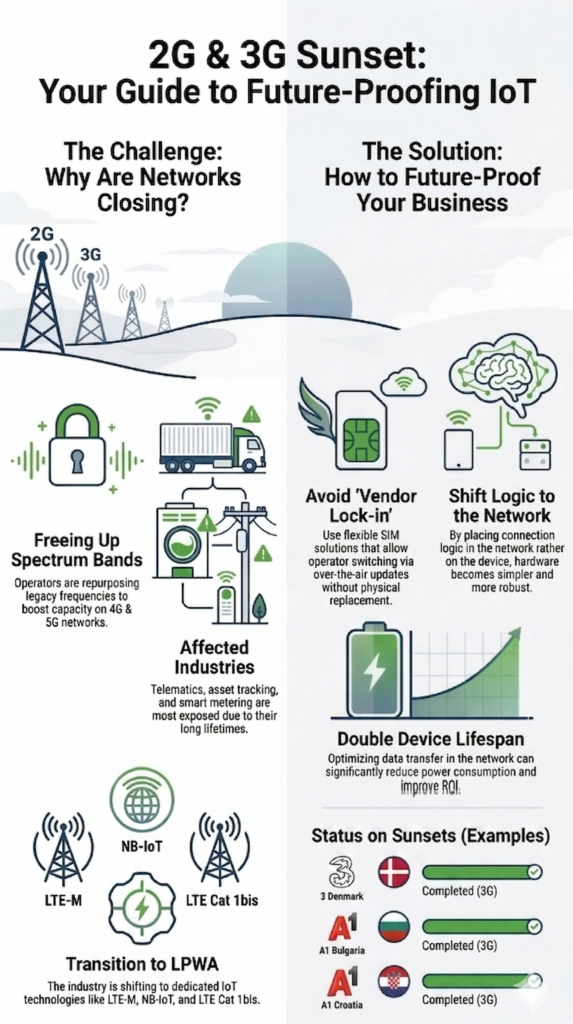
To free up spectrum for 4G and 5G networks, operators worldwide are now actively “sunsetting”—permanently shutting down—their 2G and 3G infrastructure.
This global 3G sunset poses massive challenges for industries relying on long-term Internet of Things (IoT) deployments, such as smart meters, telematics, and asset tracking. Because 3G technologies were prized by IoT developers for their low costs and global infrastructure, the shutdown forces operators to urgently transition their devices. To survive the sunset and future-proof their solutions, IoT providers are now transitioning to Low-Power Wide-Area (LPWA) network alternatives like LTE-M and NB-IoT, while actively shifting network logic to the cloud to optimize data transfer and avoid SIM vendor lock-in.