
5G NR – Empowering a Fully Connected Society
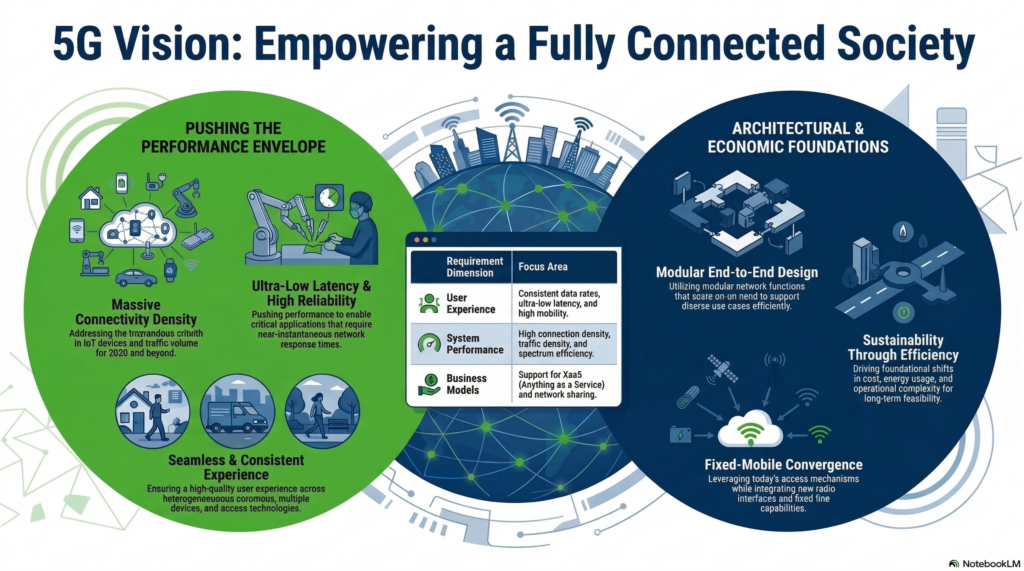
The fifth generation of mobile technology (5G) is fundamentally transforming the digital landscape, enabling a fully mobile and connected society while empowering immense socio-economic transformations. Unlike previous cellular generations that primarily focused on improving consumer broadband speeds, 5G introduces unprecedented capabilities to support an infinite variety of use cases, ranging from massive Internet of Things (IoT) deployments to ultra-reliable, mission-critical industrial applications. Guided by global standardization bodies like the 3GPP, 5G architectures offer immense flexibility through virtualized network slicing, cloud-native deployments, and edge computing. Furthermore, as 5G continues to scale globally, the industry is actively developing “5G-Advanced” technologies to integrate artificial intelligence, extended reality (XR), and advanced energy-saving mechanisms by 2025. This white paper explores the foundational standards, technical enablers, vertical industry applications, sustainability principles, and future roadmaps of 5G networks.
1. The Foundation of 5G Standards and Architecture
To avoid global fragmentation and ensure seamless interoperability of mobile devices across different countries and manufacturers, a unified global standard is essential. The International Telecommunication Union (ITU) establishes the vision and requirements for 5G, while the 3rd Generation Partnership Project (3GPP) creates the technical specifications to meet these goals.
The 3GPP officially laid the groundwork for the 5G era with Release 15, introducing the global 5G New Radio (NR) standards. This new radio specification operates over a greater range of frequencies, including millimeter waves, and guarantees forward compatibility to allow for new applications without compromising the network.
Initial 5G rollouts rely on a Non-Standalone (NSA) architecture, which leverages existing 4G LTE radio and core networks as an anchor while utilizing the 5G network for managing the data plane. To unlock the full potential of 5G, operators are transitioning to a Standalone (SA) architecture, which utilizes a dedicated 5G Core (5GC) network for both control and data channels. This new core utilizes a service-based architecture, driven by cloud-based computing and network virtualization, to enable flexible development and scaling of new services.
2. Key Capabilities and Technical Enablers
5G pushes the performance envelope significantly beyond 4G LTE, fulfilling three main technical aims defined by the ITU:
- Enhanced Mobile Broadband (eMBB): Delivering exceptionally fast data speeds ranging from 100Mbps at the cell edge to peak rates of 20Gbps per user. This is critical for bandwidth-heavy services like high-definition video, virtual reality, and providing seamless connectivity in crowded areas.
- Ultra Reliable and Low Latency Communications (URLLC): Achieving latency as low as 1ms, URLLC supports time-sensitive, mission-critical services such as autonomous driving and remote industrial control.
- Massive Machine-Type Communications (mMTC): Creating an environment capable of connecting up to 1,000,000 IoT devices per square kilometer, which is essential for smart cities and smart agriculture.
To deliver these robust capabilities, 5G utilizes advanced radio technologies. Beamforming focuses radio signals directly at the user to maximize millimeter wave frequencies, while Massive MIMO significantly improves spectral efficiency.
Crucially, Network Slicing allows carriers to create dedicated, virtual data pipelines customized for specific services over a single physical infrastructure, ensuring guaranteed Quality of Service (QoS) for distinct applications. This capability, combined with Edge Computing—which localizes processing close to the end-user for ultra-low latency—provides a highly agile and efficient platform.
3. Empowering Vertical Industries
In the 5G era, mobile network operators (MNOs) act as comprehensive solution providers for “Verticals”—distinct enterprise and industry segments. By leveraging physical and virtual private network extensions and network slicing, 5G pushes real-time data, intelligence, and predictive capabilities to the edge for these industries.
Key vertical industry transformations include:
- Manufacturing: 5G replaces inflexible wired connections with ultra-reliable wireless control, enabling real-time monitoring of automated processes, high-precision positioning for logistics, and augmented reality for maintenance.
- Transport and Automotive: Connected and autonomous driving rely on 5G for the transmission of high-quality road condition data, precise vehicle positioning, intelligent collision avoidance, and direct communication between vehicles (V2X).
- Health: 5G networks support the continuous transmission of vital signs from patient wearables to remote medical staff, the operation of remote-guided surgeries, and real-time high-definition video from ambulances to hospitals.
- Smart Cities and Agriculture: Intelligent urban infrastructure utilizes massive sensor networks for environmental monitoring, traffic management, and security. In agriculture, “AgBots” (driverless tractors and automated harvesters) and drone imaging optimize land and crop management.
4. Social Responsibility and Sustainable Networks
As mobile networks manage massive data traffic and diverse applications, the environmental and social impact of 5G is a primary concern. The industry is committed to digital inclusion, ensuring broadband connectivity and services are ubiquitous to minimize the digital divide. 5G networks are also designed to provide vital, resilient support during emergency crises and disasters, ensuring business continuity and essential communication capabilities.
Environmentally, the deployment of 5G must be heavily scrutinized to prevent an unsustainable rise in network energy consumption. Optimizing energy efficiency is a fundamental 5G design principle, aiming for a 2000x increase in energy efficiency over a ten-year timeframe. Solutions include efficient coding, transmission on demand, and advanced sleep modes.
Furthermore, the industry is increasingly focusing on the equipment environmental footprint. It is imperative to minimize the critical raw materials utilized in network infrastructure and user equipment, utilizing Life Cycle Assessments (LCA) to monitor material extraction, promote efficient material use, and facilitate the recycling and upcycling of telecom hardware.
5. The Road to 5G-Advanced and Beyond
5G is the fastest-growing mobile generation in history. To sustain this growth, the 3GPP has initiated the next evolutionary phase, officially branded as 5G-Advanced, beginning with Release 18 for deployment in the 2025 timeframe.
5G-Advanced introduces highly intelligent network solutions through the extensive integration of Artificial Intelligence (AI) and Machine Learning (ML). AI/ML algorithms will be utilized across the New Radio (NR) air interface and network layers to enable data-driven, adaptive optimization of highly complex networks.
Key features of 5G-Advanced include:
- Enhancements for Extended Reality (XR): Upgraded resource allocation and scheduling will combat jitter and latency, drastically improving immersive Virtual Reality (VR) and Augmented Reality (AR) experiences.
- Reduced Capability (RedCap) IoT: Further complexity and cost reductions for RedCap UE (User Equipment) will expand the 5G ecosystem to a broader array of scalable cellular IoT devices.
- New Spectrum (FR3): 5G-Advanced looks to exploit upper mid-band spectrum (7.125 GHz to 24.25 GHz), offering a highly promising balance of wide-area coverage and massive bandwidth capacity.
Summary
The jump from 4G to 5G represents far more than an increase in mobile broadband speed; it introduces an entirely new, cloud-native digital foundation designed to serve as the backbone of global industries and smart societies. Through the standardization of New Radio (NR), network slicing, and edge computing, 5G provides customized, ultra-reliable, and highly scalable solutions for virtually any vertical market.
As the telecommunications industry looks toward 2025 and beyond, 5G-Advanced promises to embed artificial intelligence directly into the network ecosystem, powering next-generation XR and IoT applications. Ultimately, maintaining a focus on global open standards, sustainable energy practices, and deep partnerships between network operators and vertical industries will be the critical success factors in realizing the full, transformative potential of 5G technology.