
Aviation Communications: ATC, ACARS, and ADS-B Technology Overview
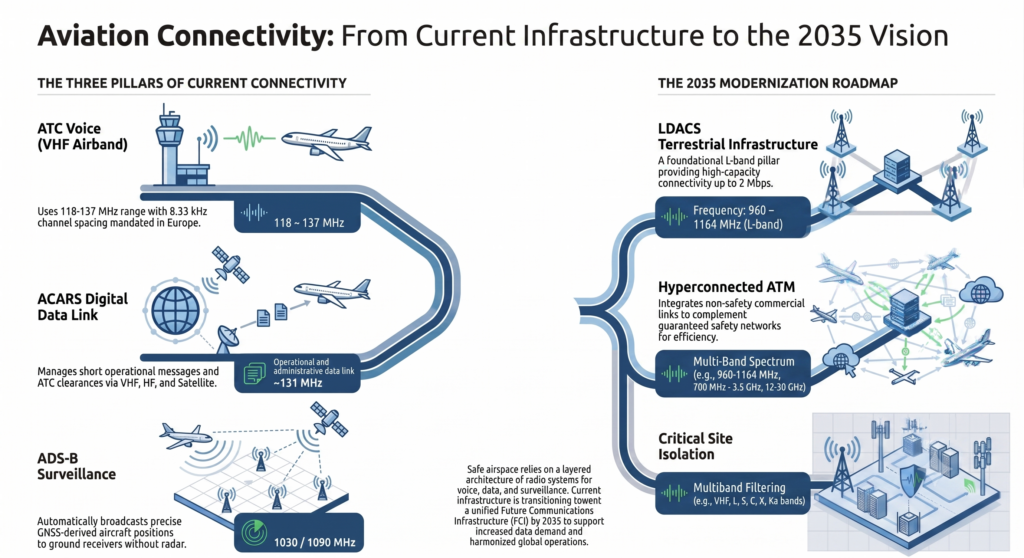
Aviation relies on a set of complementary radio systems to support safe, sustainable, and efficient Air Traffic Management (ATM) and airline operations. However, the aviation sector is currently facing significant challenges, including predicted increases in global air traffic and ambitious environmental sustainability targets. Current communication infrastructures, such as VHF Data Link Mode 2 (VDLm2), are facing severe congestion and are expected to reach a capacity crunch in continental airspace between 2028 and 2030. To overcome these limitations, the digital transformation of ATM is required, transitioning toward a Future Communications Infrastructure (FCI) based on a multi-link approach. This white paper provides an overview of foundational legacy systems like ATC voice, ACARS, and ADS-B, alongside emerging, high-capacity technologies such as LDACS, SATCOM, AeroMACS, and Hyperconnected ATM, which together will form the backbone of next-generation aviation connectivity.
1. Legacy and Current Aviation Technologies
ATC Voice and 8.33 kHz Channel Spacing Air traffic control (ATC) relies heavily on the 118-137 MHz VHF airband, utilizing amplitude-modulated (AM) voice to keep controllers and pilots in contact. To satisfy the continuously growing demand for new frequency assignments and to alleviate severe spectrum congestion, the ICAO EUR Region has mandated a transition to 8.33 kHz channel spacing. This implementation allows for better frequency re-use and is crucial to meet all VHF COM frequency demands and prevent delays in airspace improvements through 2025 and beyond.
ACARS (Aircraft Communications Addressing and Reporting System) ACARS is a foundational digital data link designed for short operational and administrative messages between aircraft and ground stations. Operating primarily on the VHF band around 131 MHz—with HF and satellite media used for oceanic and remote regions—it carries critical operational data such as Out, Off, On, In (OOOI) reports, periodic position data, and ATC clearances like CPDLC. While reliable, legacy ACARS networks are facing significant bandwidth limitations as modern fleets generate massively larger volumes of data.
ADS-B (Automatic Dependent Surveillance – Broadcast) ADS-B is a next-generation surveillance technology where aircraft internally derive their precise position from GNSS and automatically broadcast it outward. Operating globally on the 1090 MHz Extended Squitter (1090ES) and utilizing the 978 MHz UAT in the United States, it provides frequent, highly precise surveillance without the need for traditional radar, feeding vital data directly to ATC and traffic services.
Ground Infrastructure All of these legacy systems depend on highly reliable, wide-band, and band-specific VHF/UHF and L-band antennas at airports and remote sites. Co-siting these systems demands rigorous filtering and isolation to maintain signal integrity and prevent interference.
2. The Future Communications Infrastructure (FCI)
As aviation moves toward advanced operational concepts like Trajectory-Based Operations (TBO) and flight-centric ATM, there is an essential need for high-capacity, secure, and low-latency connectivity. The FCI relies on several emerging multi-link technologies to offload congested VHF bands.
LDACS (L-band Digital Aeronautical Communications System) LDACS is a broadband, secure, terrestrial data communications system specifically designed to meet the stringent requirements of modern ATC.
- Capacity and Performance: Operating in the 960 to 1164 MHz L-band, LDACS uses a cellular-like architecture based on Orthogonal Frequency-Division Multiplexing (OFDM). It provides data throughput between 500 kbps and 2.6 Mbit/s, which is nearly 200 times greater than existing VDLm2 networks, and guarantees low latency (below 100 ms) suitable for safety-critical operations.
- Resilience and Security: As a distributed cellular system, it avoids single points of failure and incorporates a dedicated Public Key Infrastructure (PKI) for mutual entity authentication and data security.
- Deployment: LDACS is highly cost-effective because ground stations can reuse existing VHF radio sites, while aircraft installations can share antennas and cabling with current VHF equipment. It is officially positioned as the medium- to long-term successor to VDLm2 in continental airspace.
SATCOM (Satellite Communications) Satellite systems are a critical component of the FCI, providing essential connectivity in oceanic and remote airspaces where terrestrial ground stations cannot reach. Dedicated L-band safety systems, such as Inmarsat SB-Safety and Iridium Certus, support secure voice and broadband data and are being enhanced to meet continental performance requirements. Additionally, emerging Ku/Ka band and LEO/MEO constellations offer massive throughput for cabin connectivity and non-safety operational data.
Hyperconnected ATM This innovative concept integrates non-safety commercial communication networks—such as public 4G/5G or commercial Ku/Ka SATCOM—into the aircraft’s safety communications architecture. By using these public links as a complement to safety networks, Hyperconnected ATM can significantly increase bandwidth capacity cost-effectively. It relies on a high-assurance monitoring mechanism to automatically fall back onto safety links (like VDL2 or SATCOM Class B) if the commercial link fails to deliver data in a timely manner.
AeroMACS (Aeronautical Mobile Airport Communication System) AeroMACS is a WiMAX-based radio access network operating in the globally reserved C-band (5091-5150 MHz). It provides high-capacity, localized connectivity tailored specifically to support ATC and airline operations on the airport surface.
Networks, Protocols, and Autonomy To support a seamless multi-link environment, aviation networks are shifting from legacy OSI and ACARS protocols to the Internet Protocol Suite (IPS). IPS provides a state-of-the-art framework that enables end-to-end security, native mobility, and unified aircraft architectures. Furthermore, as autonomous vehicles and Remotely Piloted Aircraft Systems (RPAS) integrate into controlled airspace, robust Command and Control (C2) links operating over dedicated C-band spectrum will be vital to ensure safe, transparent operations alongside manned aircraft.
Summary
The future of aviation connectivity relies on moving away from single, congested VHF channels toward an integrated, digital multi-link ecosystem. While legacy systems like ATC voice, ACARS, and ADS-B remain foundational to airspace safety and navigation, the looming capacity crunch necessitates advanced, high-throughput solutions. Terrestrial networks like LDACS, combined with advanced SATCOM, AeroMACS, and the strategic integration of commercial broadband via Hyperconnected ATM, will deliver the necessary bandwidth, cyber-security, and low latency required for modern airspace management. This cohesive transition, underpinned by IPS networks, is vital to accommodating global traffic growth, enabling efficient trajectory-based operations, and achieving the aviation industry’s long-term environmental sustainability targets.