GSM-R – The Secure Communications Backbone for Global Rail
GSM-R (Global System for Mobile communications – Railways) is the international wireless standard for railway operational communication. Developed by the International Union of Railways (UIC) based on the ETSI/3GPP GSM standard, GSM-R serves as the proven voice and signaling backbone of European rail. Operating across more than 100,000 kilometers of track worldwide, it provides secure communication between trains and control centers, forming the critical communications layer of the European Rail Traffic Management System (ERTMS). This white paper explores the origins, architecture, specialized features, safety integrations, and future migration path of the GSM-R standard.
1. The Origins and Standardization of GSM-R
Before the 1990s, European railways relied on fragmented, incompatible analog radio systems. To achieve cross-border interoperability, the UIC and the European Commission launched the EIRENE (European Integrated Radio Enhanced NEtwork) project in 1992 to specify the requirements for a mobile network that could fulfill railway needs.
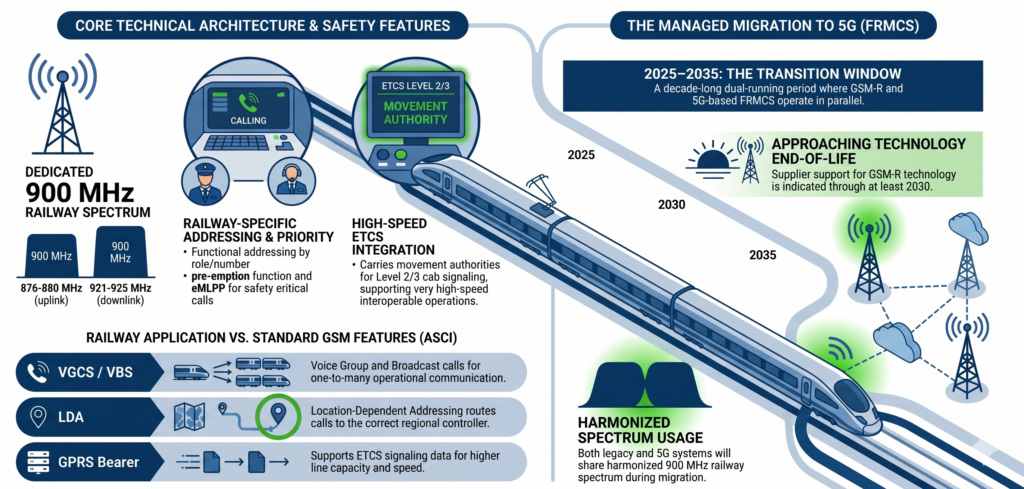
Following the decision to adopt GSM technology, the European Frequency Committee (CEPT) allocated a dedicated frequency band for railway use: 876-880 MHz for the uplink and 921-925 MHz for the downlink. To validate that the EIRENE specifications could be successfully implemented, a consortium of railways and suppliers launched the MORANE (MObile Radio for RAilway Networks in Europe) project in 1996, which tested the system on pilot lines in France, Italy, and Germany. This culminated in a 1997 Memorandum of Understanding (MoU) signed by 32 railways, committing them to cease investments in analog systems and transition exclusively to GSM-R.
2. Core Architecture and Specifications
GSM-R is built on the standard circuit-switched GSM core but is adapted heavily with railway-specific functions. The network architecture consists of Base Station Sub-systems (BSS), Network Sub-systems (NSS) including Mobile Services Switching Centers (MSCs), and General Packet Radio Service (GPRS) infrastructure.
The technical baseline of GSM-R is strictly governed by two primary documents:
- The EIRENE Functional Requirements Specification (FRS): Defines the functional needs of the system to ensure core railway functionality and international interoperability.
- The EIRENE System Requirements Specification (SRS): Defines the technical requirements that the radio system must comply with to achieve these functions.
To interact with this network, several standardized categories of Mobile Equipment are utilized:
- Cab radios: Mounted inside the train for driver communications.
- General purpose radios: Standard handheld radios for general railway staff.
- Operational and Shunting radios: Specialized handhelds for trackside workers and shunting teams.
- ETCS data only radios (EDOR): Dedicated modules for transmitting train control data.
3. Railway-Specific Capabilities
To meet the stringent operational demands of railways, GSM-R incorporates features far beyond standard public cellular networks:
- Group and Broadcast Calling: It supports Voice Group Call Service (VGCS) and Voice Broadcast Service (VBS), allowing controllers to instantly communicate with specific groups of trains or trackside workers in a defined area.
- Advanced Addressing: Standard cellular networks route calls by phone numbers, but GSM-R utilizes Functional Addressing, allowing users to call a specific role (e.g., “Driver of Train 1234”) without knowing the hardware number. Location-Dependent Addressing ensures that a call from a train is automatically routed to the correct local controller based on the train’s current geographic location.
- Shunting Mode: A specialized communication mode used by personnel actively moving and coupling train cars. It includes an audible Link Assurance Signal transmitted periodically so users immediately know if the radio connection breaks during these dangerous maneuvers.
4. ERTMS Integration and Safety Systems
A primary function of GSM-R is serving as the communication bearer for the European Train Control System (ETCS), which is the signaling component of ERTMS. GSM-R carries ETCS signaling data (movement authorities), which enables the removal of physical lineside signals and allows for higher line capacities and train speeds. This data can be transmitted over a circuit-switched bearer or via packet-switched GPRS/EGPRS connections.
For safety, GSM-R utilizes Enhanced Multi-Level Precedence and Pre-emption (eMLPP), ensuring that critical calls override lower-priority traffic. The most critical of these is the Railway Emergency Call (REC), a highest-priority alert used to warn drivers and controllers of a dangerous situation, which can instruct trains to immediately reduce speed or stop. An updated version, enhanced REC (eREC), improves this by allowing emergency calls to be targeted to highly specific tracks or sectors, minimizing unnecessary halts to trains in safe, adjacent areas.
5. The Future Migration to FRMCS
While GSM-R is a mature and highly reliable standard, the underlying 2G/GSM technology is approaching its end-of-life around the year 2030. To secure the future of railway communications, the industry is preparing to migrate to the Future Railway Mobile Communication System (FRMCS).
FRMCS will be based on modern 5G technology. Because railway operations cannot be paused for a network upgrade, the industry is preparing for a long, dual-running migration period expected to span from 2025 to 2035. During this decade-long transition, GSM-R and FRMCS will operate in parallel, sharing harmonized 900 MHz railway spectrum to ensure seamless communication and safety as older systems are phased out.
Summary
GSM-R has successfully unified European railway voice and signaling communications, replacing a fractured landscape of analog systems with a secure, standardized, and highly interoperable digital network. Through its specialized features—such as Functional Addressing, priority pre-emption, and seamless ETCS integration – it remains the critical operational backbone of modern rail. As the industry looks toward the 5G-based FRMCS, the robust foundation established by the EIRENE and MORANE projects ensures that GSM-R will continue to safely guide trains throughout the extensive transition period concluding in 2035.