
dPMR: A Guide to Spectrum-Efficient Digital Radio
Digital Private Mobile Radio (dPMR) is an open, non-proprietary digital two-way radio standard developed by the European Telecommunications Standards Institute (ETSI). It is designed to deliver a spectrum-efficient, low-cost, and low-complexity solution that caters to professional, commercial, and consumer users. By utilizing 6.25 kHz Frequency Division Multiple Access (FDMA) technology, dPMR effectively doubles the channel capacity of traditional 12.5 kHz systems without the need for complex time-synchronization infrastructure
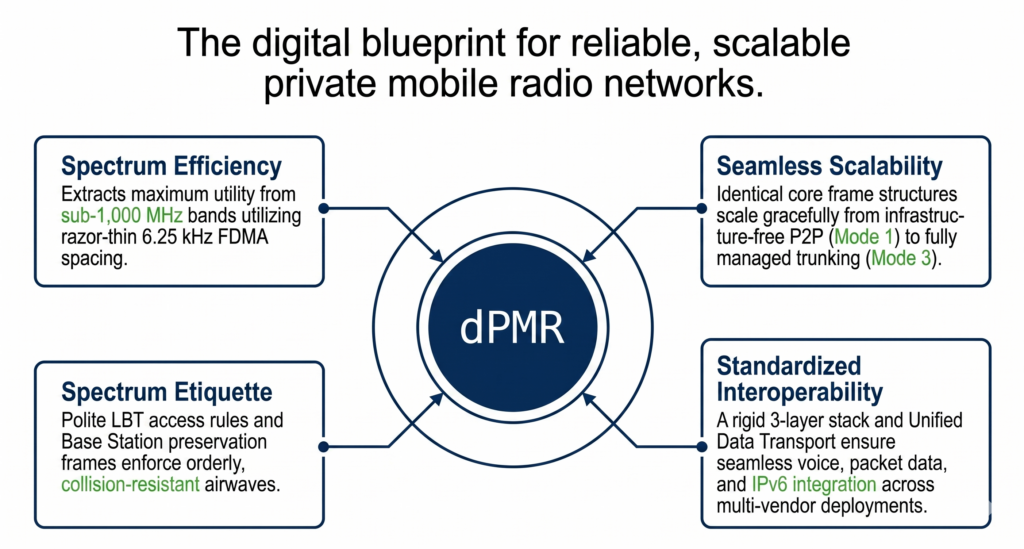
1. Introduction to dPMR and Spectrum Efficiency
dPMR was introduced in 2007 to meet tightening regulatory demands for 6.25 kHz channel equivalence. The defining technical characteristic of dPMR is its true 6.25 kHz FDMA access method, which places one independent conversation on each narrow carrier.
This presents a distinct architectural difference from Time Division Multiple Access (TDMA) systems, such as DMR. TDMA achieves 6.25 kHz equivalence by dividing a single 12.5 kHz channel into two alternating 30-millisecond timeslots. In contrast, dPMR’s FDMA approach divides the 12.5 kHz channel in length, creating two fully independent 6.25 kHz channels. This true narrowband approach allows users to double their usable spectrum capacity without requiring a repeater base station to synchronize time slots, significantly simplifying single-channel and license-free deployments.
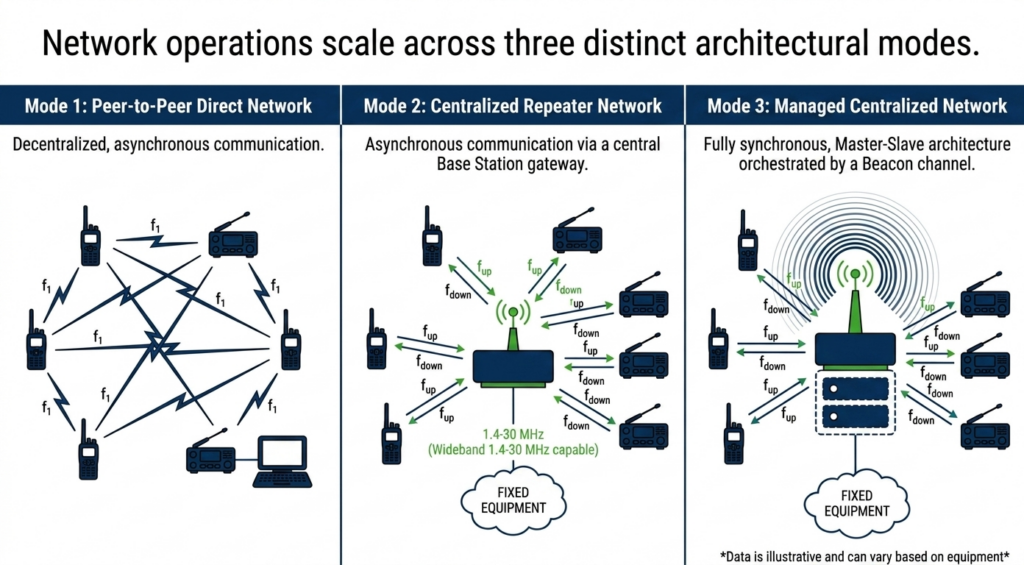
2. Operating Modes and Scalability
dPMR is developed in tiers and functional levels to offer a completely scalable communication solution, extending from consumer use to mission-critical applications.
- Tier 1 (dPMR446): Defined by ETSI Technical Specification TS 102 490, this is a low-cost, license-exempt format. It operates in the 446 MHz UHF band as a peer-to-peer system using a maximum of 500 mW of power, without base stations or repeaters.
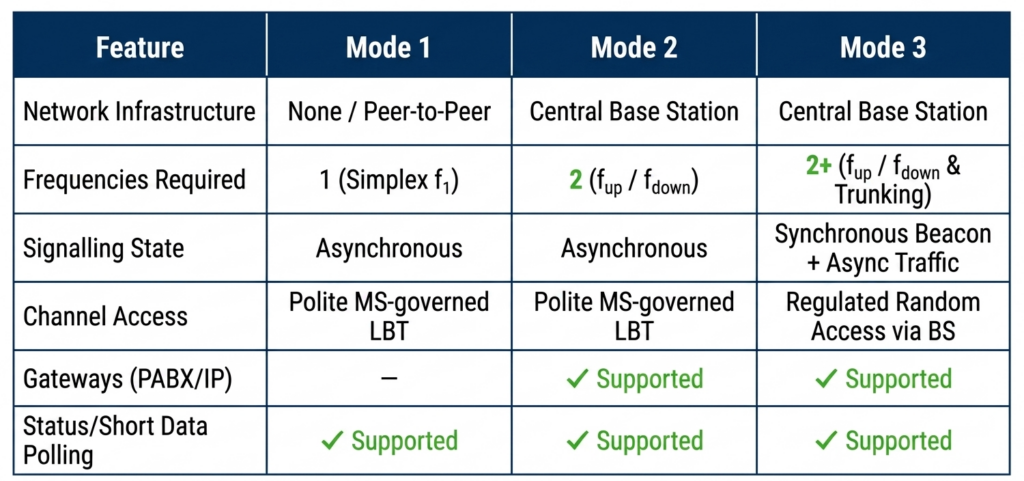
- Tier 2 (Licensed PMR): Defined by ETSI TS 102 658, Tier 2 is designed for the licensed professional market and is sub-divided into three operational modes:
- Mode 1 (Direct / Peer-to-Peer): Provides unit-to-unit communication without network infrastructure, serving as the basis for all licensed PMR use.
- Mode 2 (Conventional Repeater): Incorporates base stations and repeaters to extend radio coverage across wide areas, allowing for interfaces via gateways to telephone networks or IP.
- Mode 3 (Trunked): A centrally managed, multi-site trunking system that dynamically allocates a pool of channels to maximize capacity for high-density organizations. It utilizes a dedicated beacon channel to continuously manage MS (Mobile Station) channel access, registration, and traffic routing.
3. Voice Quality and Performance
As an end-to-end digital standard, dPMR provides consistent and highly intelligible voice clarity in environments where traditional analog signals would fade into static and noise. dPMR utilizes 4-level frequency-shift keying (4FSK) modulation paired with an AMBE+2 digital vocoder to deliver natural-sounding voice within its extremely narrow 6.25 kHz bandwidth.
To further enhance audio integrity, dPMR incorporates Forward Error Correction (FEC), which detects and corrects transmission errors across the coverage area. Additionally, digital processing actively suppresses background noise, vastly improving intelligibility for users in loud industrial, manufacturing, or outdoor settings. Finally, the inherent low transmit power and narrowband operation of the platform contribute to excellent power efficiency, supporting extended battery life over long shifts.
4. Integrated Data and Advanced Features
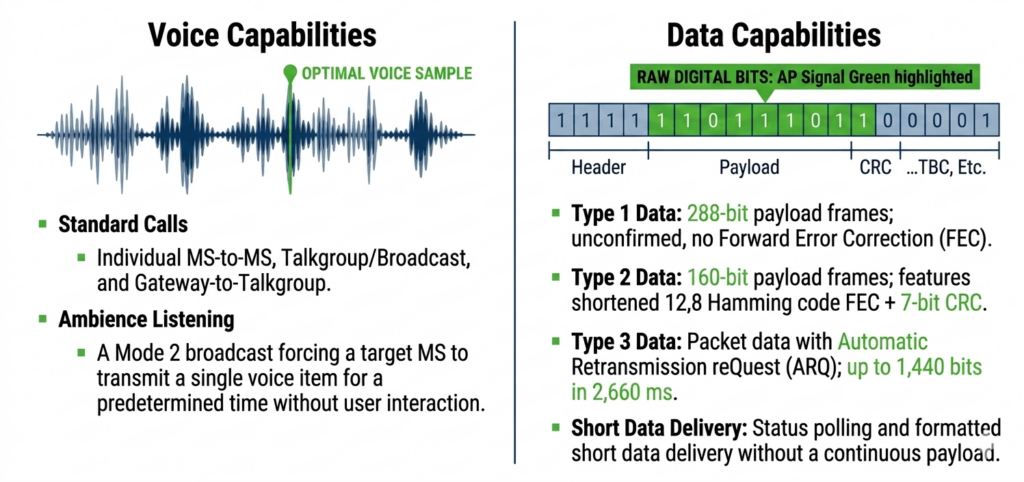
Despite its low-complexity framework, dPMR does not lack the advanced functionality required by operations-critical users. It integrates voice and data, utilizing a Unified Data Transport (UDT) mechanism to smoothly transfer short data, IP addresses, PABX/PSTN dialing digits, and complementary data between radios and base stations.
Key features and capabilities include:
- Comprehensive Call Types: Supports individual calls, talkgroup calls, all-calls, and broadcast calls, as well as late entry into active group communications.
- Integrated Data: Supports short data messages (SDM), status polling, GPS/location delivery via NMEA protocols, and telemetry applications.
- Worker Safety: Equipped with Emergency Call functions, Man Down alerts, and Lone Worker features for staff in hazardous environments. It also features Ambience Listening, allowing a base station to remotely open an MS microphone for a set period.
- Security and Fleet Manaement: Administrators can utilize remote Stun, Revive, and permanent Kill commands for lost or stolen devices. It also supports digital voice scrambling and stronger encryption algorithms (such as AES).
5. Interoperability and Migration
Because dPMR is published as an open ETSI standard, it fosters a dynamic, competitive ecosystem among multiple equipment manufacturers and software developers. The dPMR Association ensures that product classes are tested and certified for compliance, which prevents vendor lock-in, drives down end-user costs, and guarantees that equipment from different suppliers will interoperate flawlessly.
For organizations currently utilizing legacy analog PMR, dPMR provides a highly logical, cost-effective migration pathway. Equipment certified for dPMR can feature automatic mixed-mode operation, seamlessly switching between analog FM and digital dPMR to maintain communications between old and new fleets during the transition period. Furthermore, for existing users of analog MPT 1327 trunked systems, dPMR Mode 3 provides an immediate digital upgrade path without compromising system features.
Summary
dPMR stands as a highly efficient, feature-rich, and future-ready digital communication technology. By leveraging true 6.25 kHz FDMA, it delivers maximum spectral efficiency and scalable infrastructure that serves everything from simple license-free handsets to expansive, multi-site trunked networks. With its commitment to open standards, seamless analog-to-digital migration paths, integrated data routing, and pristine digital voice clarity, dPMR is an optimal choice for organizations requiring robust, cost-effective professional radio capabilities without the burden of complex network design.