
P25: A Standard for Global Public Safety Interoperability
Project 25 (P25) is a long-standing, user-driven digital radio standard designed to ensure seamless interoperability for first responders and government agencies. Developed through a collaboration between public safety professionals and manufacturers, the suite of standards supports mission-critical voice and data communications across diverse geographic and frequency landscapes.
1
Introduction to Project 25 (P25)
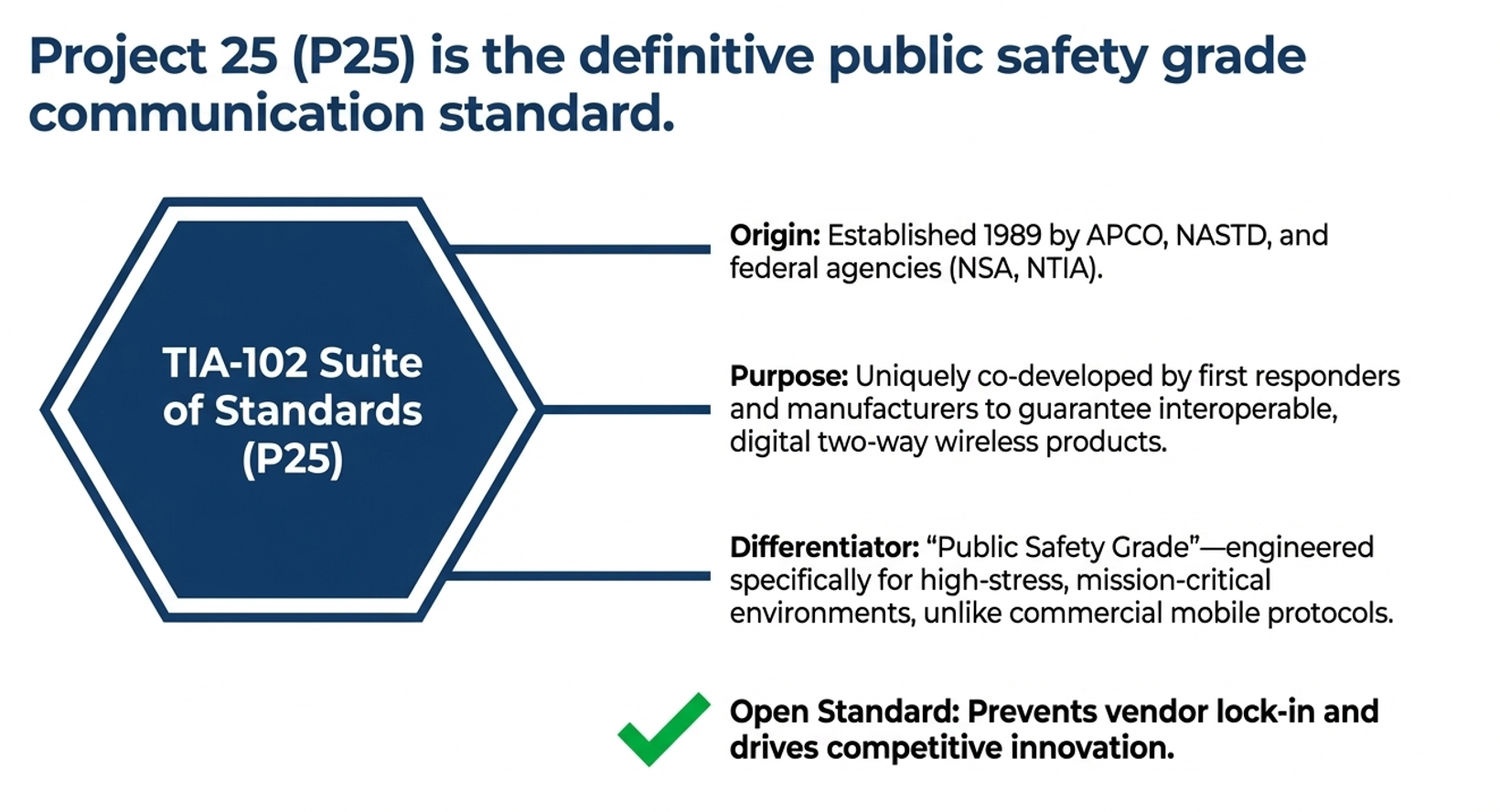
1. Introduction to Project 25 (P25) Project 25 (P25) is an open, user-driven communications standard established in 1989 by a coalition of public safety organizations and government agencies, including the Association of Public Safety Communications Officials (APCO), NASTD, and the NSA.
- Designed specifically for “Public Safety Grade” communications, P25 ensures interoperability among multiple manufacturers’ products.
- The standard was created to maximize radio spectrum efficiency, guarantee a competitive multi-vendor market, and provide highly reliable, mission-critical communications for first responders and other essential industries like utilities and transit.
2
The Evolving P25 Standards and Interfaces
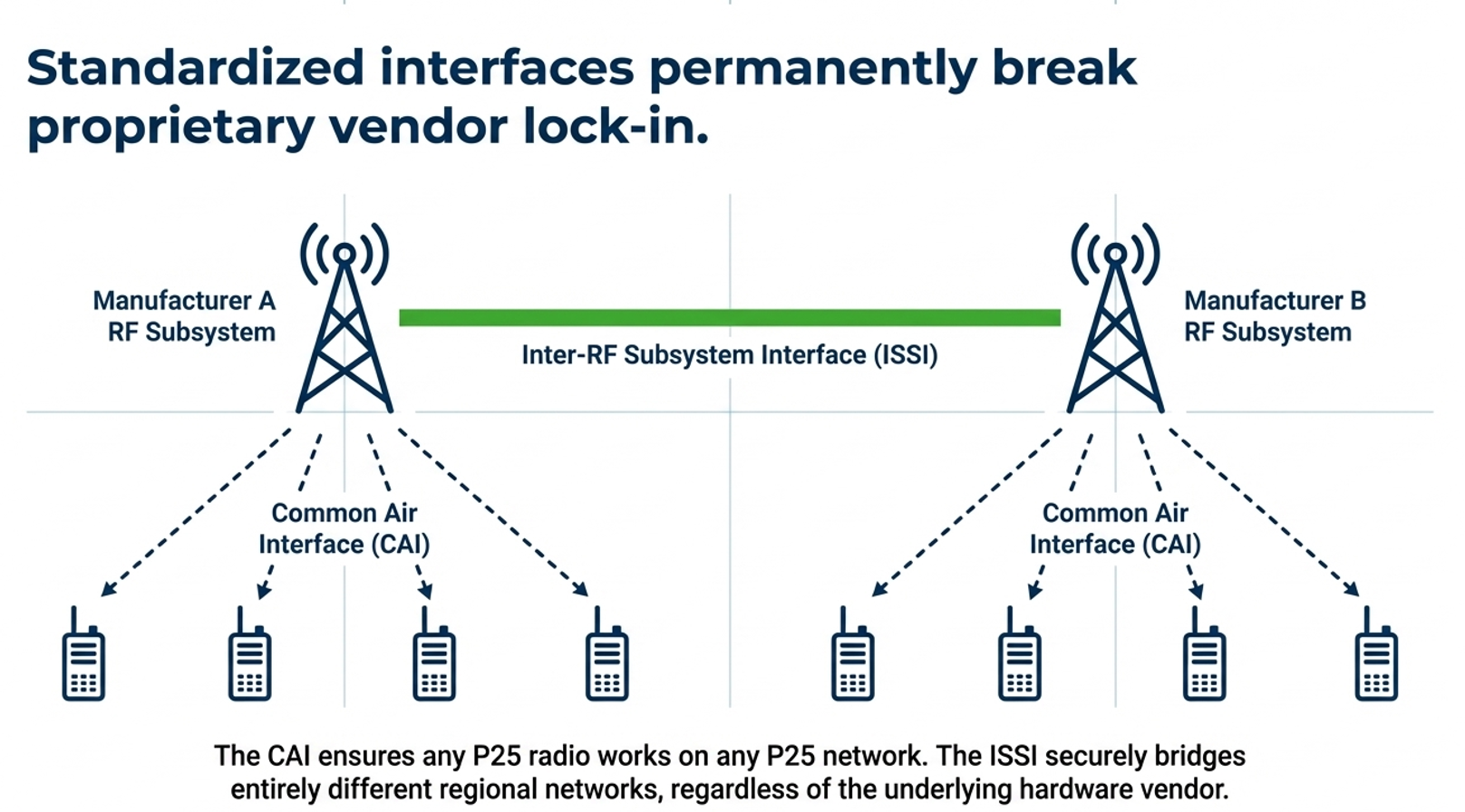
At the heart of P25 interoperability is the Common Air Interface (CAI), which specifies the digital signals transmitted by compliant radios regardless of the manufacturer.
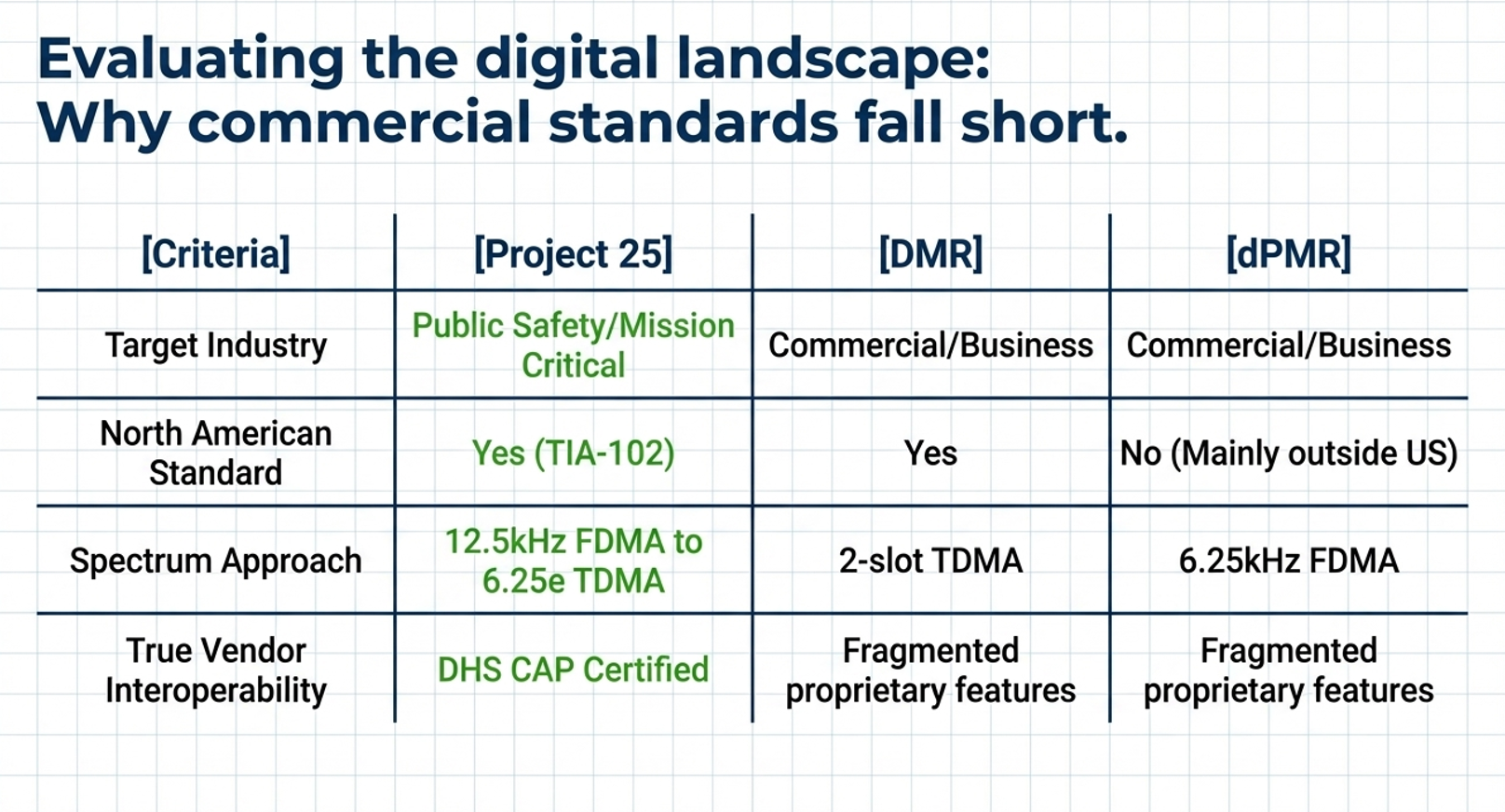
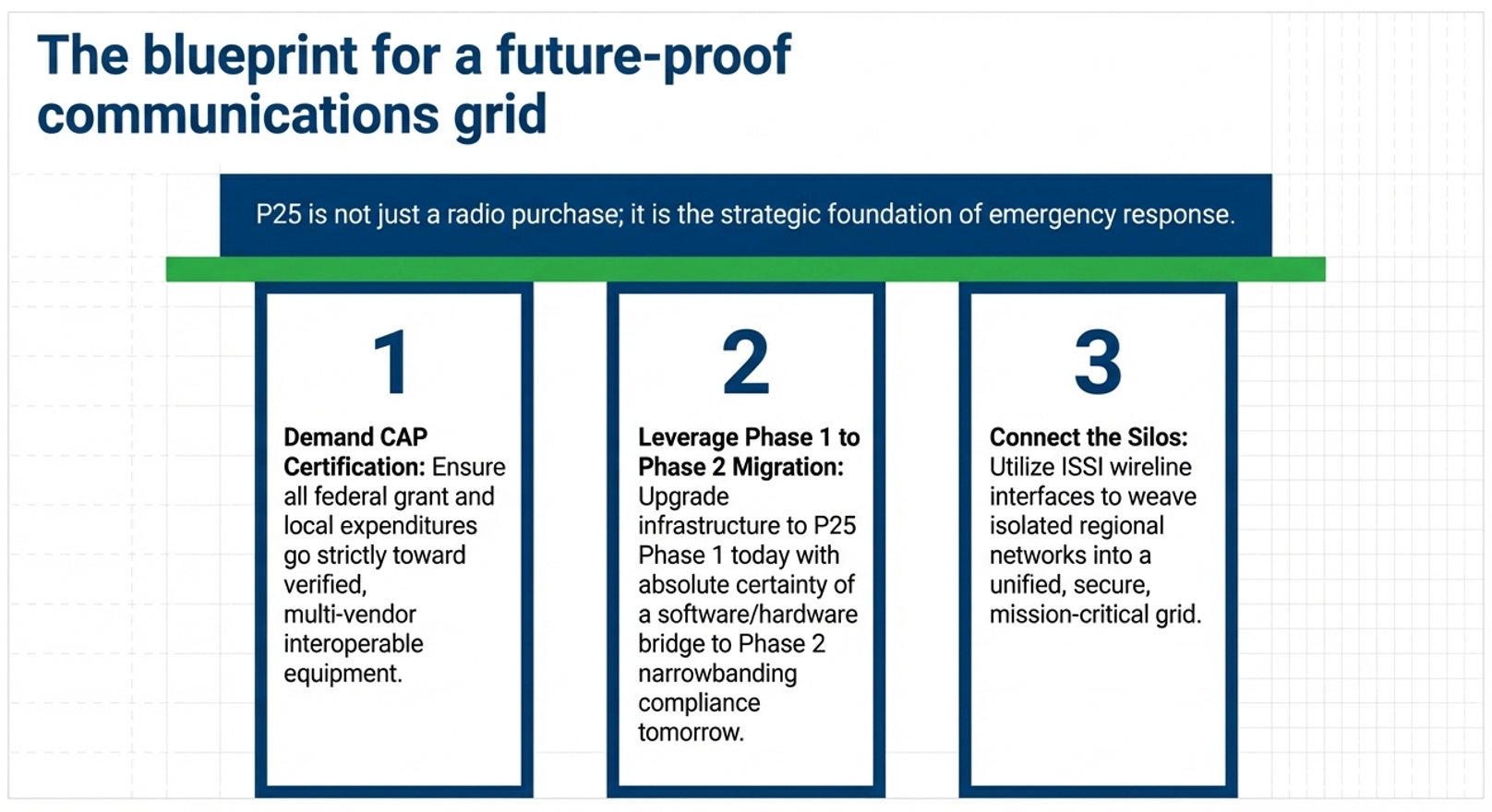
- To improve spectral efficiency, P25 operates in two primary phases: Phase 1 utilizes 12.5 kHz Frequency Division Multiple Access (FDMA) channels, while Phase 2 employs Time Division Multiple Access (TDMA) to fit two separate voice or data streams into a single 12.5 kHz channel.
- Beyond over-the-air protocols, P25 defines critical wireline interfaces like the Inter-RF Subsystem Interface (ISSI) for connecting disparate networks together, the Console Sub-System Interface (CSSI), and the Fixed Station Interface (FSI).
3
System Architecture and Flexibility
P25 provides highly flexible operational designs to meet diverse agency needs, supporting conventional, trunked, and simulcast system architectures.
- Conventional operation relies on fixed channels chosen manually by users, offering a highly reliable and cost-effective solution for agencies with lower user density.
- Trunked operation uses a centralized computer controller to dynamically assign users to a pool of shared channels, maximizing frequency efficiency for high-density environments and supporting advanced features like call queuing.
- Furthermore, P25 digital equipment is backward-compatible with legacy analog FM systems, allowing agencies to migrate their fleets gradually as their budgets allow.
4
Security and Advanced Services
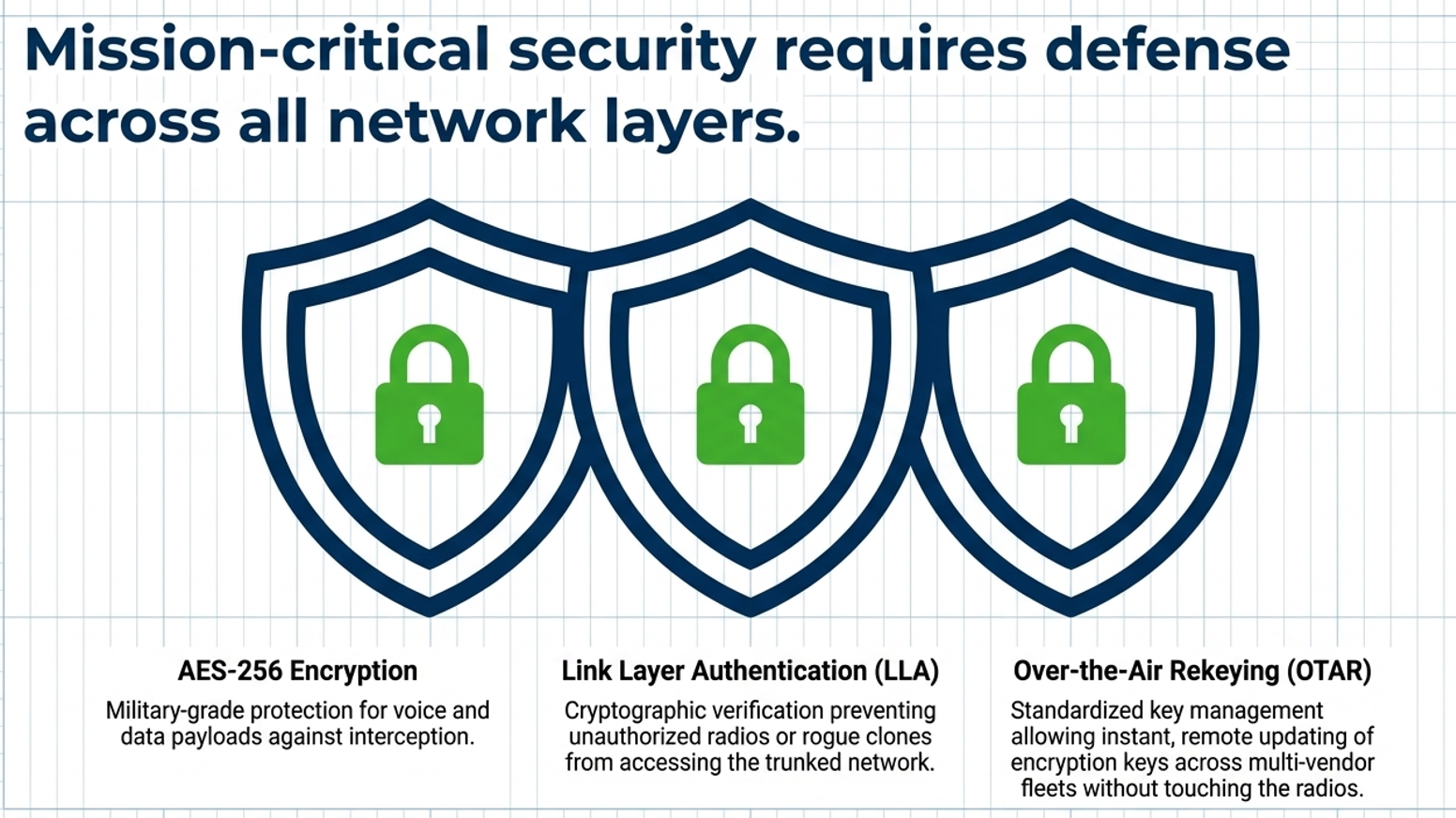
Robust security is essential for modern public safety, and P25 offers a rigorous “Defense in Depth” approach.
- Voice and data transmissions are protected by advanced digital encryption, most notably the 256-bit Advanced Encryption Standard (AES).
- Unlike legacy analog encryption, P25 digital encryption maintains crystal-clear speech intelligibility and does not degrade the usable range of the radio system.
- The standard also supports Over-the-Air Rekeying (OTAR), enabling administrators to securely deliver new encryption keys to radios wirelessly without needing to physically handle each device.
- Additionally, P25 networks support valuable data features such as Tier 1 and Tier 2 location services to track personnel and vehicles in real-time
5
Interoperability and Future Convergence
Interoperability is a primary objective of P25, enabling seamless communication during routine operations, massive mutual-aid responses, and multi-agency task forces.
- To guarantee equipment compatibility across different vendors, products undergo rigorous, independent testing through the government-recognized P25 Compliance Assessment Program (CAP).
- Looking to the future, the P25 standard is actively evolving to ensure seamless interworking functions between Land Mobile Radio (LMR) networks and 3GPP broadband LTE cellular systems, ensuring that LMR and broadand technologies can effectively coexist and communicate.
Summary
Project 25 serves as the foundational, non-proprietary standard for public safety communications across North America and is deployed in over 80 nations globally. By mandating open standards and rigorous compliance testing, P25 prevents vendor lock-in and fosters a highly competitive marketplace that continually drives innovation and lowers costs. With its flexible architecture, unparalleled digital security features, and ongoing adaptations for broadband integration, P25 ensures that first responders can focus entirely on their mission rather than the limitations of their technology.