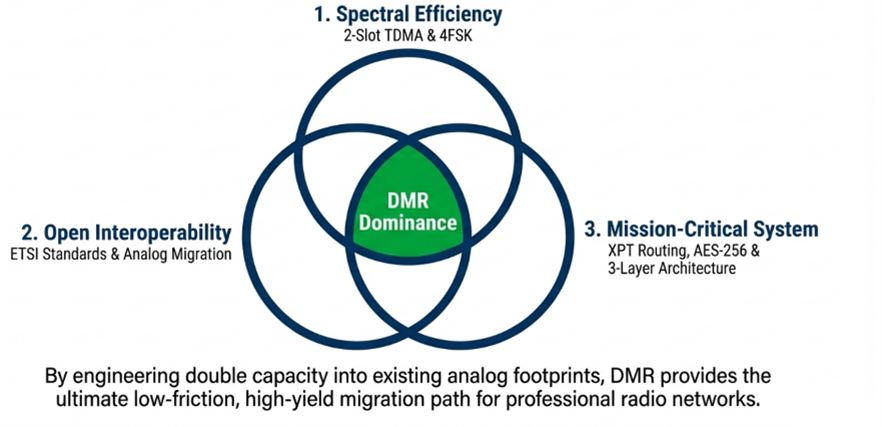


Digital Mobile Radio (DMR) is an international digital radio standard developed by the European Telecommunications Standards Institute (ETSI) and first ratified in 2005. Designed to replace legacy analog Land Mobile Radio (LMR) systems, DMR provides an affordable, low-complexity digital upgrade that utilizes existing frequency licenses while delivering improved voice clarity, enhanced security, integrated data applications, and double the channel capacity. This white paper outlines the technological foundations, system architectures, and operational benefits of DMR two-way radio systems.
The DMR Standard and Tiers
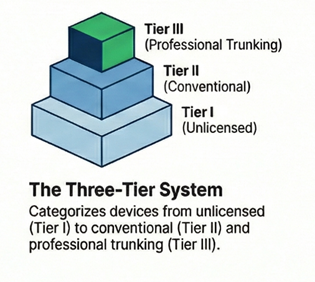
The DMR standard was engineered to offer professional, commercial, and private users a robust communication platform. It is structured into three distinct tiers to meet varying operational requirements:
– Tier I (Unlicensed): Operates in direct mode (unit-to-unit) on public frequencies with a maximum transmit power of 500mW. It is ideal for individuals, small retail, or recreational use without the need for wide-area coverage.
– Tier II (Licensed Conventional): Designed as a direct replacement for conventional analog systems, operating under individual licenses. It uses repeaters to extend coverage and is targeted at users needing spectral efficiency, advanced voice features, and IP data services.
– Tier III (Licensed Trunked): A fully managed trunking system that uses a centralized controller to automatically regulate communications and assign channels dynamically. It is ideal for large-scale operations migrating from legacy trunking systems like MPT-1327, offering extensive voice and packet data support, including IPv4 and IPv6.
Core Technological Advantages
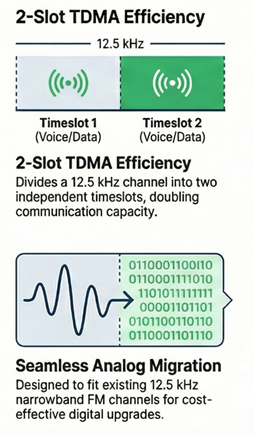
Time-Division Multiple Access (TDMA) and Spectral Efficiency A fundamental advantage of DMR is its use of two-slot TDMA technology, which divides a single 12.5 kHz channel into two alternating timeslots. This effectively doubles the calling capacity of a single frequency, allowing two simultaneous, independent conversations.
This TDMA architecture provides substantial infrastructure cost savings compared to Frequency Division Multiple Access (FDMA) systems like dPMR. While FDMA achieves a similar 6.25 kHz channel equivalence, it
requires two separate repeaters and expensive combining equipment to operate both sub-channels simultaneously. DMR’s TDMA approach allows users to achieve double capacity using a single repeater, antenna, and duplexer, vastly simplifying network design and migration from analog.
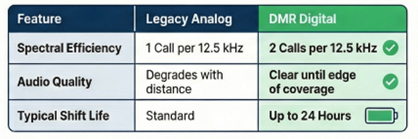
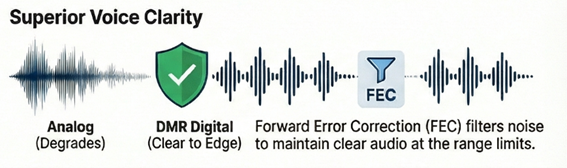
Advanced Modulation and Voice Clarity DMR uses 4FSK (Four-level Frequency Shift Keying) modulation, operating at 4,800 symbols per second. Unlike analog signals that degrade steadily as signal strength weakens, DMR utilizes Forward Error Correction (FEC) and Cyclic Redundancy Check (CRC) coders to detect and correct transmission errors. Digital processing screens out background noise and reconstructs degraded transmissions, delivering superior voice quality right up to the farthest edges of the coverage area.
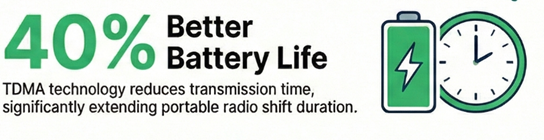
Enhanced Power Efficiency Because a DMR radio operating in TDMA mode only transmits during its assigned timeslot, the transmitter is idle for half of the communication period. This reduction in transmit duration leads to an improvement in battery life of up to 40% compared to analog radios, allowing devices to comfortably last through extended shifts without requiring a recharge.
Data Integration and Worker Safety
Because DMR is an end-to-end digital standard, it inherently supports data transmission alongside voice.
– Integrated Data: DMR networks support text messaging (both free-form and quick pre-programmed texts), GPS location tracking, and telemetry. GPS data can be transmitted simultaneously with voice calls for immediate location targeting, enhancing visual dispatch applications.
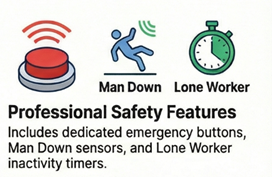
Worker Safety Features: DMR includes critical safety protocols for users in hazardous environments. Features include Man Down (triggering an alarm if a radio rests at a specific angle for too long), Lone Worker (requiring periodic user check-ins), and a dedicated Emergency Button. Additionally, Priority Interrupt allows dispatchers to instantly clear a busy channel to broadcast urgent emergency information.
Scalable System Architectures
DMR systems can scale from simple peer-to-peer setups to nationwide trunked networks:
– Tier II Conventional Base Stations: Utilizes a single repeater site to extend range across a facility or campus. Base stations can support unified gateways for interoperability with PSTN, PBX, LTE, and analog networks.
– IP Connect: Connects multiple Tier II repeaters across different geographic locations using standard IP networks (LAN, WAN, VPN, or internet). This creates a seamless, wide-area network where users can roam between sites while maintaining communication.
– Pseudo Trunking (e.g., Hytera XPT): A cost-effective extension of Tier II that provides trunking capabilities without requiring a dedicated, licensed control channel (FCC FB8). It dynamically allocates up to 16 voice channels across multiple repeaters, automatically shifting users to a “Free Repeater” if their “Home Repeater” is busy, thus eliminating busy signals and maximizing capacity.
– Tier III Digital Trunking: Designed for mission-critical and large-scale enterprise deployments (such as Specialized Mobile Radio networks). It utilizes a dedicated control channel and a central Mobile Switching Office (MSO) with triple failover redundancy. It offers advanced features like late entry, call queuing, dynamic group allocation, and strict user access control.
Security, Interoperability, and Co-existence
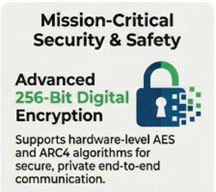
Encryption and Security DMR protects communications against eavesdropping much more effectively than basic analog voice scramblers. It supports multiple levels of security, including basic encryption via key IDs, and enhanced end-to-end encryption using robust ARC4 (40-bit) and AES (256-bit) algorithms. Additional network security includes Radio Authentication (ESN checking) to prevent unauthorized devices from accessing the system, as well as remote “Stun and Revive” capabilities to disable lost or stolen radios.
Interoperability The DMR Association oversees a rigorous Interoperability (IOP) Process to guarantee that equipment from different manufacturers works together seamlessly. This open-standard approach prevents vendor lock-in, reduces costs through competition, and allows organizations to select the most appropriate products for their needs.
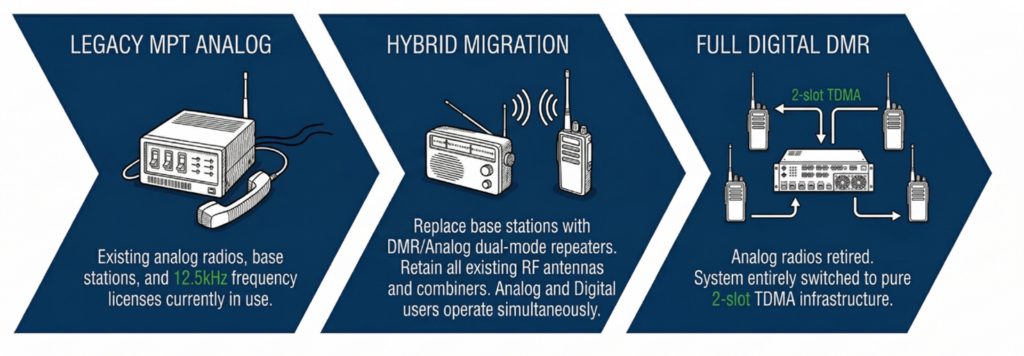
Analog Migration and Spectrum Co-existence DMR was explicitly designed for a smooth transition from analog systems like MPT-1327. DMR radios can operate in dual analog/digital modes, allowing organizations to replace aging analog radios over time before upgrading the core infrastructure.
To peacefully co-exist with existing analog traffic on shared frequencies, DMR employs Listen Before Transmit (LBT) protocols, which check the channel’s signal strength (RSSI) to prevent transmission over active calls. Devices can be configured as “Polite to all” (yielding to any analog or digital traffic) or “Polite to own color code”. “Color codes” function similarly to analog sub-audible tones, allowing multiple user groups to share a frequency without opening their speakers to unrelated traffic. Furthermore, DMR equipment adheres to stringent electromagnetic compatibility standards (EN 300 113 and FCC equivalents), ensuring they do not introduce greater frequency drift or adjacent-channel interference than legacy analog radios.
Summary
Digital Mobile Radio (DMR) provides a future-proof, highly scalable communication standard. By leveraging 2-slot TDMA technology, DMR doubles channel capacity without the need for new spectrum licenses or complex antenna combining equipment. With robust voice quality, built-in data integration, stringent encryption, and a seamless migration path from legacy analog systems, DMR stands as the premier choice for organizations seeking mission-critical reliability and operational efficiency.