
Login required
You need to be logged in into your account to view downloadable documents.
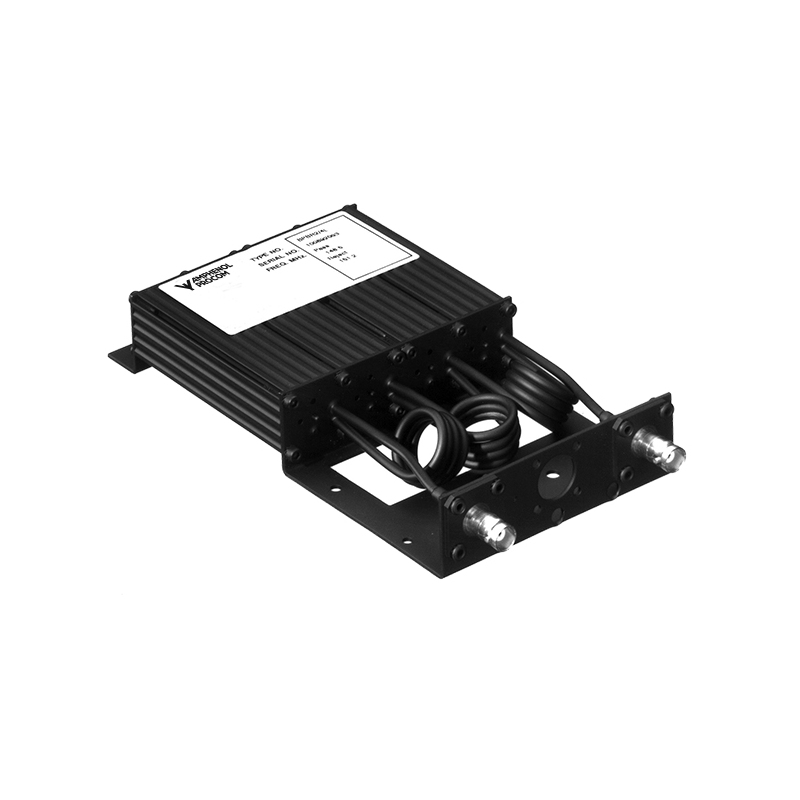
| Electrical | |
| Model | BPBR 2/4 / BRBP 2/4 |
|---|---|
| Filter Type | Band-pass / band-reject filters |
| Frequency | 136 – 175 MHz |
| Max. Input Power | 50 W |
| Pass Band Insertion Loss | Single-channel tuned ≤ 1.0 dB Multi-channel tuned, 1.5 MHz BW ≤ 1.2 dB |
| Impedance | 50 Ω |
| Pass-Reject Spacing | 4 – 10 MHz (see table) |
| Reject Attenuation | Single channel tuned > 90 dB Multi channel tuned, 1.5 MHz BW > 60 dB |
| VSWR | ≤ 1.5:1 |
| Environmental | |
| Frequency Stability | Approx. 10 ppm / °C |
|---|---|
| Operating temperature range | -30 °C to +60 °C |
| Mechanical | |
| Connection(s) | BNC(f) |
|---|---|
| Historic Brand | Amphenol Procom |
| Dimensions | 210 x 104 x 33 mm / 8.26 x 4.09 x 1.29 in. |
| Weight | Approx. 0.6 kg / 1.32 lb. |
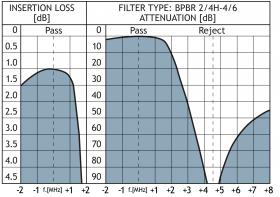
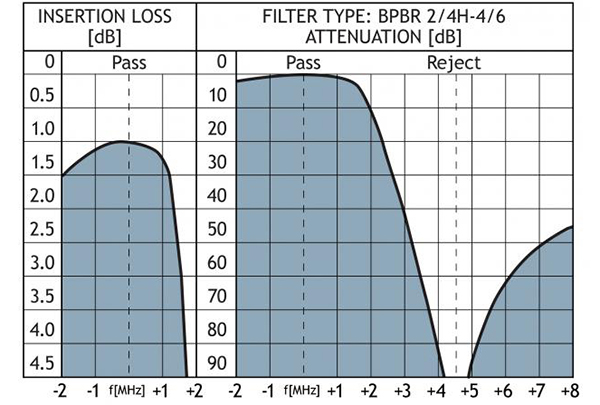
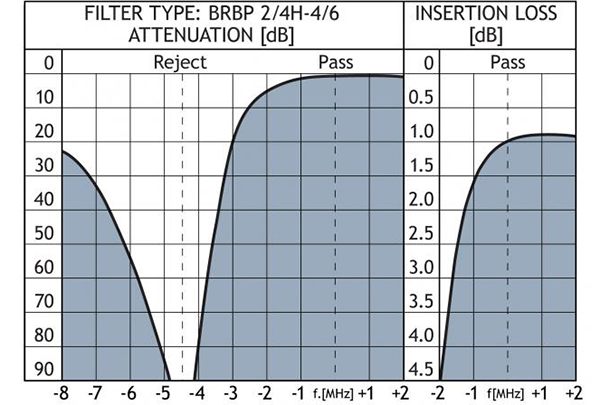
TYPICAL RESPONSE CURVES @ 4.5 MHz DUPLEX SPACING
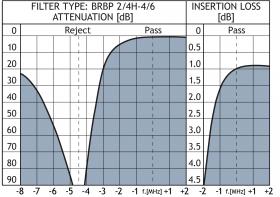
TYPICAL RESPONSE CURVES @ 4.5 MHz DUPLEX SPACING
| Model | Product No. | Frequency | Additional Information | Add To Quote |
|---|---|---|---|---|
|
BPBR 2/4 L-4/6 |
200001349 | 136 – 154 MHz | SPACING: 4 – 6 MHz | |
|
BRBP 2/4 L-4/6 |
200001474 | 136 – 154 MHz | SPACING: 4 – 6 MHz | |
|
BPBR 2/4 L-6/8 |
200001350 | 136 – 154 MHz | SPACING: 6 – 8 MHz | |
|
BRBP 2/4 L-6/8 |
200001478 | 136 – 154 MHz | SPACING: 6 – 8 MHz | |
|
BPBR 2/4 L-8/10 |
200001351 | 136 – 154 MHz | SPACING: 8 – 10 MHz | |
|
BRBP 2/4 L-8/10 |
200001479 | 136 – 154 MHz | SPACING: 8 – 10 MHz | |
|
BPBR 2/4 H-4/6 |
200001345 | 152 -175 MHz | SPACING: 4 – 6 MHz | |
|
BRBP 2/4 H-4/6 |
200001468 | 152 -175 MHz | SPACING: 4 – 6 MHz | |
|
BPBR 2/4 H-6/8 |
200001328 | 152 -175 MHz | SPACING: 6 – 8 MHz | |
|
BRBP 2/4 H-6/8 |
200001463 | 152 -175 MHz | SPACING: 6 – 8 MHz | |
|
BPBR 2/4 H-8/10 |
200001337 | 152 -175 MHz | SPACING: 8 – 10 MHz | |
|
BRBP 2/4 H-8/10 |
200001465 | 152 -175 MHz | SPACING: 8 – 10 MHz |
You need to be logged in into your account to view downloadable documents.
If pass and reject frequencies are stated when ordering, the filters are delivered factory-adjusted. Ordering example : BRBP 2/4…, LOW : 149.5 MHz, HIGH : 154.0 MHz. In this case, further information is not required.
When ordering untuned filters please use the model selection table above to select the appropriate ordering designation for the desired filter type.
Click below to sign up for our monthly newsletter to keep informed about our latest products and news from Amphenol Procom.