
Login required
You need to be logged in into your account to view downloadable documents.
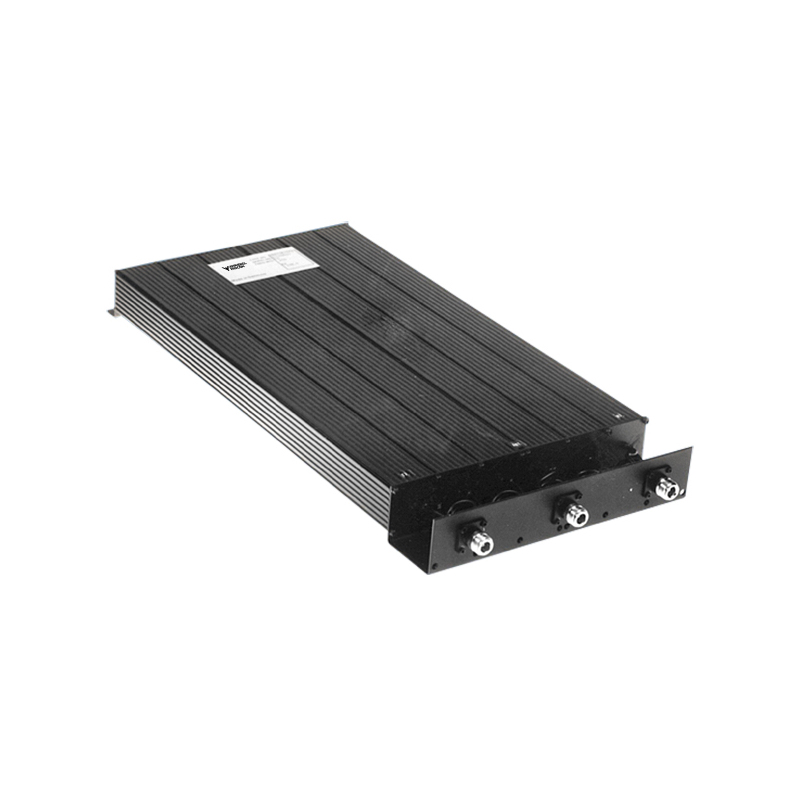
| Electrical | |
| Model | DPF 2/6-150… |
|---|---|
| Frequency | DPF 2/6-150 L : 138 – 156 MHz DPF 2/6-150 H : 152 – 175 MHz |
| Max. Input Power | 150 W |
| Special spec. info |
Single-channel tuned:Multi-channel tuned
BW = 1.5 MHz: |
| Insertion Loss Tx-Ant and Ant-Rx |
< 1.2 dB (typ. 1.0 dB)< 1.4 dB (typ. 1.2 dB)
|
| Tx Noise Suppression on Rx Frequency |
> 80 dB> 60 dB
|
| Isolation Rx on Frequency Tx |
> 80 dB> 60 dB
|
| Impedance | 50 Ω |
| Duplex Spacing | 1 – 10 MHz |
| VSWR | ≤ 1.5:1 |
| Environmental | |
| Frequency Stability | Approx. 4.5 ppm / °C |
|---|---|
| Operating temperature range | -30 °C to +60 °C |
| Mechanical | |
| Connection(s) | N(f) (BNC(f), TNC(f), UHF(f) or SMA(f) on request) |
|---|---|
| Historic Brand | Amphenol Procom |
| Dimensions | 519.5 (excl. conn.) x 250 x 50 mm / 20.45 (excl. conn.) x 9.84 x 1.97 in. |
| Weight | Approx. 4.5 kg / 9.92 lb. |
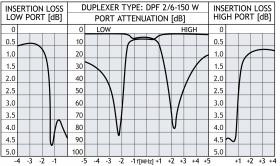
TYPICAL RESPONSE CURVES @ 4.5 MHz DUPLEX SPACING
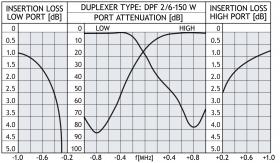
TYPICAL RESPONSE CURVES @ 1.6 MHz DUPLEX SPACING
| Model | Product No. | Frequency | Additional Information | Add To Quote |
|---|---|---|---|---|
|
DPF 2/6-150 L-1/2-N(f) |
200000204 | 138 – 156 MHz | SPACING: 1 – 2 MHz | |
|
DPF 2/6-150 L-2/4-N(f) |
200000216 | 138 – 156 MHz | SPACING: 2 – 4 MHz | |
|
DPF 2/6-150 L-4/6-N(f) |
200000209 | 138 – 156 MHz | SPACING: 4 – 6 MHz | |
|
DPF 2/6-150 L-6/8-N(f) |
200001863 | 138 – 156 MHz | SPACING: 6 – 8 MHz | |
|
DPF 2/6-150 L-8/10-N(f) |
200001864 | 138 – 156 MHz | SPACING: 8 – 10 MHz | |
|
DPF 2/6-150 H-1/2-N(f) |
200000199 | 152 – 175 MHz | SPACING: 1 – 2 MHz | |
|
DPF 2/6-150 H-2/4-N(f) |
200000198 | 152 – 175 MHz | SPACING: 2 – 4 MHz | |
|
DPF 2/6-150 H-4/6-N(f) |
200001648 | 152 – 175 MHz | SPACING: 4 – 6 MHz | |
|
DPF 2/6-150 H-6/8-N(f) |
200001649 | 152 – 175 MHz | SPACING: 6 – 8 MHz | |
|
DPF 2/6-150 H-8/10-N(f) |
200000189 | 152 – 175 MHz | SPACING: 8 – 10 MHz |
You need to be logged in into your account to view downloadable documents.
This product doesn’t have additional information yet.
Click below to sign up for our monthly newsletter to keep informed about our latest products and news from Amphenol Procom.