
No content found
This product doesn’t have any diagrams yet.
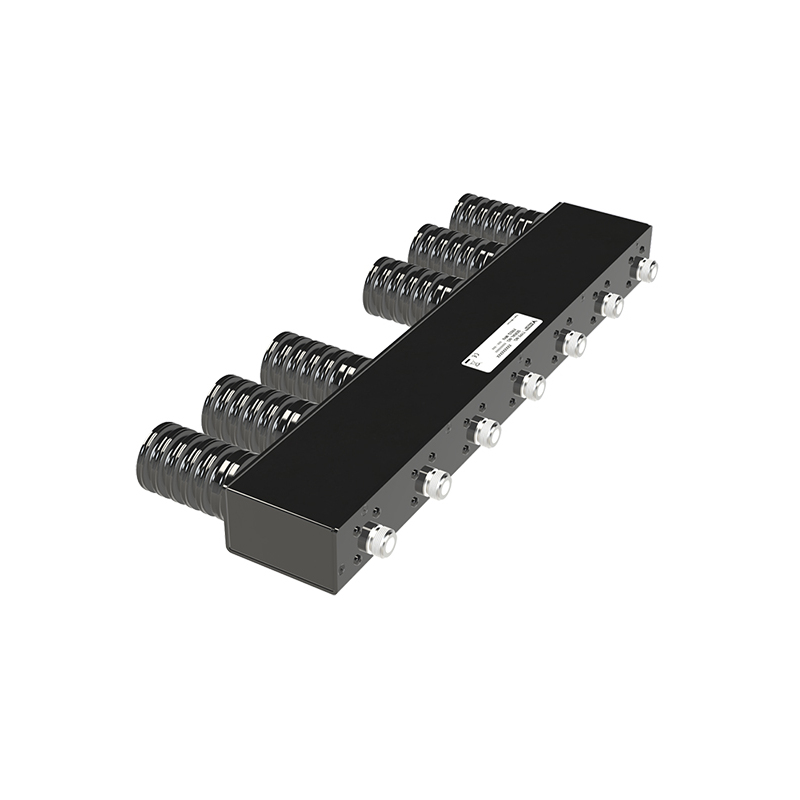
| Electrical | |
| Model | PRO-PHY450-6 |
|---|---|
| Filter Type | Hybrid Junction |
| Frequency | 380 – 480 MHz |
| Max. Input Power | 36 W per channel (max. 120 W with larger load) |
| Insertion Loss | < 9.2 dB ±0.3 dB @ 11 MHz BW < 9.5 dB ±0.3 dB @ 22 MHz BW |
| Impedance | 50 Ω |
| Isolation Tx1 – Tx2 | > 28 dB @ 11 MHz BW > 26 dB @ 22 MHz BW (*see note) |
| VSWR | < 1.5:1 with all other ports terminated with 50 Ω |
| Load | 30 W load fitted (other ratings available) (** see note) |
| No. of channels | 6 |
| Environmental | |
| Operating temperature range | -30 °C to +60 °C |
|---|---|
| Mechanical | |
| Connection(s) | N(f) |
|---|---|
| Historic Brand | Amphenol Procom |
| Dimensions | 400 x 108 (incl. conn.) x 42 mm (excl. load) / 15.75 x 4.25 (incl. conn.) x 1.65 in. (excl. load) |
| Weight | Approx. 2.31 kg / 5.08 lb. |
This product doesn’t have any diagrams yet.
| Model | Product No. | Frequency | Add To Quote |
|---|---|---|---|
|
PRO-PHY450-6-1 |
210002937 | 380 – 400 MHz | |
|
PRO-HDAR450-3DI-BB/445-460/5-5-5/50W |
Contact_84 | Low: 445 – 450 MHz / High: 455 – 460 MHz | |
|
PRO-HDAR450-3DI-BB/455-470/5-5-5/50W |
Contact_85 | Low: 455 – 460 MHz / High: 465 – 470 MHz | |
|
PRO-PHY450-6-4 |
210002824 | 410 – 430 MHz | |
|
GNSS 2000-B-FC |
Contact_86 | – | |
|
PRO-PHY450-6-6 |
210002899 | 430 – 450 MHz | |
|
PRO-PHY450-6-7 |
210002938 | 440 – 460 MHz | |
|
PRO-PHY450-6-8 |
210002822 | 450 – 470 MHz | |
|
GNSS 2000-W-FC |
Contact_87 | – | |
|
PRO-PHY450-6-2 |
Contact_57 | 390 – 410 MHz | |
|
PRO-PHY450-6-3 |
Contact_58 | 400 – 420 MHz | |
|
PRO-PHY450-6-5 |
Contact_59 | 420 – 440 MHz | |
|
PRO-PHY450-6-9 |
Contact_60 | 460 – 480 MHz |
You need to be logged in into your account to view downloadable documents.
The isolation between the Tx ports is directly dependent on the terminating VSWR on the antenna port.
With an antenna load VSWR = 1.5, the isolation between the two Tx ports will be reduced to 20 dB @ 5 MHz bandwidth.
The VSWR of the load’s should be < 1.1! Each load should be able to dissipate 5/6 of the input power.
E.g.: With 60 W input, each load should be able to dissipate 60 W x 5/6 = 50 W.
Click below to sign up for our monthly newsletter to keep informed about our latest products and news from Amphenol Procom.